Market Trends
Manesar Land Price Prediction: 2030 Scenarios and What Could Move Them
No one can give a reliable 2030 land price for Manesar, and we don't publish one. The closest guide we hold is our forecast for New Gurgaon flats, from ₹11,000 per sq ft in 2025 to between ₹13,000 and ₹16,000 by 2030, read alongside Manesar tehsil plot collector rates that rose 10.9% over two years but only 0.7% in the latest list.
 By Pranav Adhikari · Edited by
Rakesh Mahajan · · 10 min read
Can anyone predict Manesar land prices?
Not with any real confidence. We hold no land price series for Manesar, so a precise 2030 figure would be a guess, and we won't publish one. What we can offer is a labelled proxy and the official trend for plots.
The proxy is our forecast for New Gurgaon, sectors 76 to 95 beside Manesar. It's built on average asking prices for mostly flats, so read it as a direction, not a plot price. The second signal is how collector rates for residential plots moved in Manesar tehsil.
Please read this first: everything here is a projection, not investment advice. Nobody knows what Manesar land will cost in 2030, and that includes anyone selling it to you.
What does the New Gurgaon forecast say for 2030?
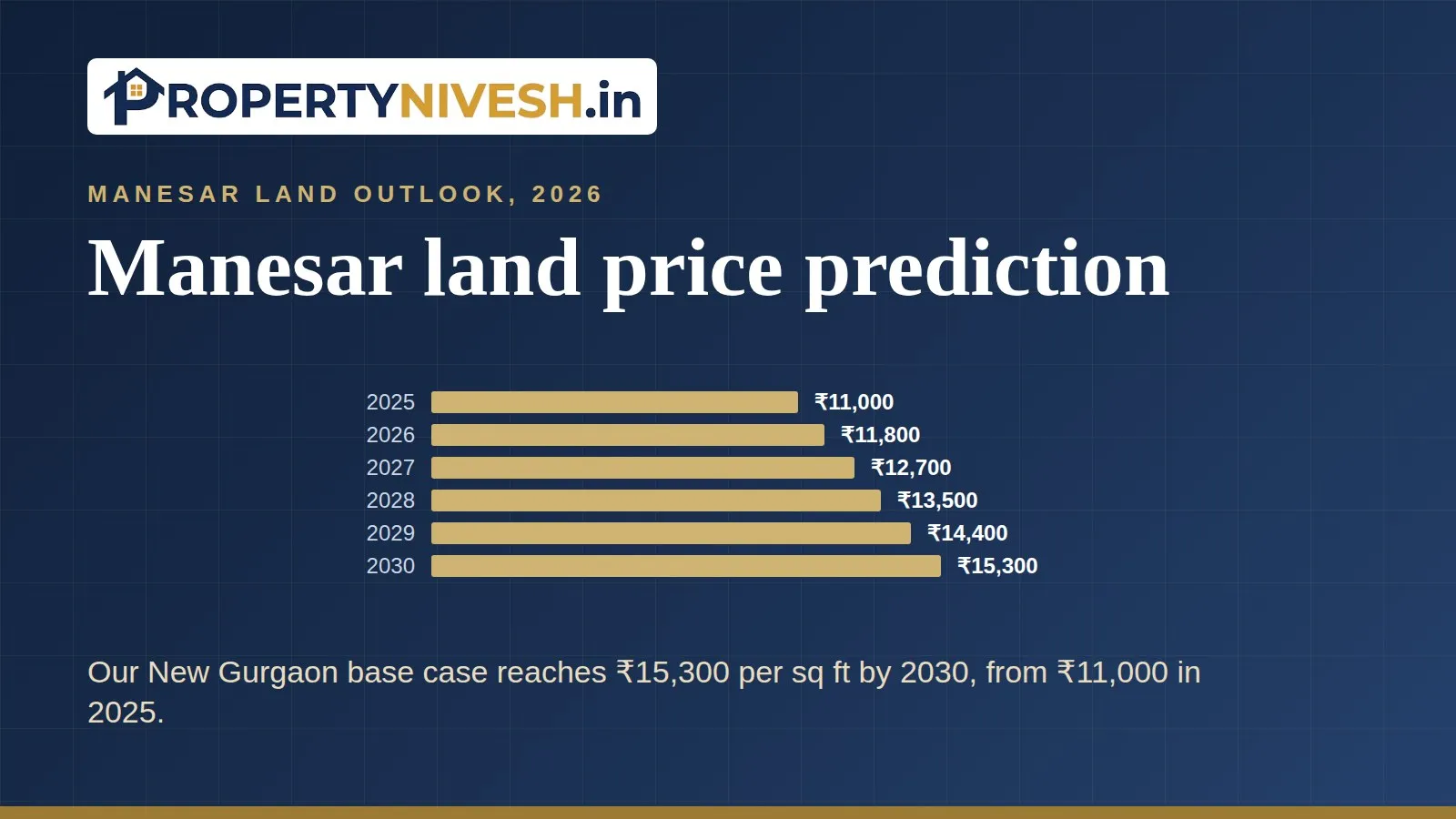
In the base case, New Gurgaon's average asking price reaches ₹15,300 per sq ft in 2030, from ₹11,000 in 2025. The low case ends at ₹13,000 and the high case at ₹16,000.
| Year | Low case | Base case | High case | Base-case growth |
|---|---|---|---|---|
| 2025 (tracked) | ₹11,000 | ₹11,000 | ₹11,000 | 7.8% (actual) |
| 2026 | ₹11,400 | ₹11,800 | ₹11,900 | 7.5% |
| 2027 | ₹11,800 | ₹12,700 | ₹12,800 | 7.1% |
| 2028 | ₹12,200 | ₹13,500 | ₹13,800 | 6.8% |
| 2029 | ₹12,600 | ₹14,400 | ₹14,900 | 6.4% |
| 2030 | ₹13,000 | ₹15,300 | ₹16,000 | 6.1% |
The chart shows New Gurgaon's tracked average from 2020 to 2025 and the base-case path to 2030. Over five years the base case adds about 39%, since ₹15,300 is 39% above ₹11,000. The low case adds about 18% and the high case about 45%.
Recent history shows how fast the pace can change. New Gurgaon rose 26.5% in 2023 and 7.8% in 2025, so a five-year path is a rough guide at best. You can follow the actual numbers on our New Gurgaon price tracker.
How is the forecast made, and why isn't it a Manesar land forecast?
It's a simple rule, not a model of Manesar. Here's the method as printed on our property rates page.
- Base case: growth starts at the area's latest yearly change, 7.8% for New Gurgaon. It moves in equal steps to a long-run pace of 6.1% a year, reaching it in year five.
- The 6.1% pace is the average yearly rise in NHB RESIDEX's 50-city index over the eight quarters from 2024-Q3 to 2026-Q2, taken from NHB press releases.
- Low case: half the base-case growth each year.
- High case: the faster of the starting and long-run pace, here 7.8%, held for five years.
- The starting pace is capped at 15% a year, and values are rounded to ₹100.
A plot's value depends on things a flat average can't see. The licence, the land-use zone, the road it faces and a clean title all matter. The method also assumes no shocks, so a rail sanction or a land dispute wouldn't show up in it. Our research methodology explains how the tracker itself is built.
Land can also swing harder than flats. A flat's price includes the cost of building it, and that part doesn't jump on news. A plot's price is mostly the land itself, so a sanction, a licence or a dispute can move it a long way in either direction.
What does the official plot trend in Manesar tehsil show?
It's mixed. Plot collector rates in Manesar tehsil rose a median 10.9% over two years, but only 0.7% in the latest list. The district raised some lines sharply and left most where they were.
The chart shows the median change in plot collector rates by tehsil in the latest list, 2025-26 to 2026-27. Manesar tehsil's 0.7% sits beside Sohna's 0.1%, while Harsaru and Badshahpur both show 25%.
| Plot line in the collector list | Change, 2025-26 to 2026-27 | Change, 2024-25 to 2026-27 |
|---|---|---|
| Manesar tehsil median (60 areas; 40 over two years) | 0.7% | 10.9% |
| Manesar village | 25.3% | 37.8% |
| Shikohpur | 25.2% | 50.3% |
| Sector 79 | 45.1% | 66.9% |
| Sector 77 | 25.1% | 43.8% |
| Sector 80 | 0.1% | 10.1% |
| Sector 87 | 0.1% | 15.2% |
| Naharpur Kasan | 0.1% | 10.1% |
| Harsaru tehsil median (32 areas; 15 over two years) | 25% | 37.5% |
| Sectors M9 to M14 (Harsaru list) | 30% | Not in both lists |
We counted the 60 Manesar tehsil plot lines: 22 rose 15% or more in the latest list and 38 moved less than 1%. A collector rate is the official minimum value for registering a property, not a market price. So a flat year doesn't prove land prices stood still, and a jump doesn't prove they rose. It does show where the official floor for stamp duty went up.
What could push Manesar land prices up?
Mostly decisions that haven't been made yet. Each item below is something you can watch for and check.
- A Union sanction for the Namo Bharat RRTS. RRTS, the Regional Rapid Transit System, is fast regional rail. The Delhi-Gurugram-SNB corridor's 2018 detailed project report (DPR) named Kherki Daula and Panchgaon among its stations. As of 9 October 2026 it had state approvals but no Union Cabinet sanction.
- The Sector 56 to Panchgaon metro moving to tender. It's planned at 35.25 km with 28 elevated stations, with state funding approved and a final DPR submitted. It's meant to meet the RRTS at Panchgaon. Our post on Panchgaon metro connectivity and property prices looks at it closely.
- TOD rules near stations. DTCP has put land within 1.5 km of 12 proposed Gurugram RRTS stations under its Transit Oriented Development (TOD) policy. That can allow extra FAR, the floor area ratio that sets how much can be built on a plot. The zone split is still pending, as our note on RRTS TOD zones explains.
- Industrial demand. The Delhi-Mumbai Industrial Corridor lists a Manesar-Bawal Investment Region in Haryana. We hold no jobs data for IMT Manesar, so this is a driver to watch, not one we can measure.
- Roads that are already open. The Haryana section of the Dwarka Expressway opened on 11 March 2024 and ends at the NH-48 interchange at Kherki Daula. It's a real link today, though it's been open long enough that some of its effect may already be in prices.
What could hold Manesar land prices back?
Title problems, stalled plans and new supply. Any of these could leave land near Manesar flat, or make it harder to sell.
- Land disputes. The ED's probe into TDI Group concerns land in Manesar, Naurangpur and Lakhnoula villages. The agency alleges that land notified for acquisition there was bought cheaply from farmers and resold after the acquisition lapsed. The Tribune reported the CBI's estimate of the farmers' loss at roughly ₹1,500 crore. Read our note on the ED raids.
- Forest land. Hindustan Times reported in October 2026 that the forest department had flagged at least five housing complexes in Naurangpur as built on forest land. A demolition drive is planned for mid-November.
- Plans that slip. The full station list for the revised RRTS alignment isn't confirmed in the sources we track. A plot sold as "near the station" may not be.
- New plotted supply. HRERA, the Haryana Real Estate Regulatory Authority, registers projects before sale. Its records show plots in Manesar-address projects arriving in bursts: 1,499 in 2021, 1,191 in 2023 and 17 so far in 2026. A fresh burst would give buyers more choice and could slow price rises.
How should you read the three scenarios for Manesar land?
Treat them as "if this happens, roughly that" stories, not predictions. They describe New Gurgaon's flat market, and Manesar land could do better or worse than any of them.
- Low case, about 18% by 2030. Growth runs at half the base pace. For Manesar land, this is the world where rail stays unsanctioned, plot collector rates stay flat and land disputes keep buyers cautious.
- Base case, about 39% by 2030. Growth eases from 7.8% to 6.1% a year. For Manesar, think of plans moving slowly while demand holds steady.
- High case, about 45% by 2030. New Gurgaon keeps its 2025 pace of 7.8% for five years. For Manesar land to keep up, you'd want to see real steps: an RRTS sanction, a metro tender and TOD zones notified.
To test your own numbers, try our property appreciation calculator with the low-case pace as well as the base case. Remember costs, too. Stamp duty in Haryana is 7% for men and 5% for women. Say a plot is worth 18% more after five years, as in the low case. Once a man's 7% stamp duty is counted, that's only about 10% above what he paid in total (1.18 divided by 1.07), before loan interest or upkeep. For a buyer-by-buyer view, read whether Manesar is good for property investment.
What to check before buying land near Manesar
Land needs more checks than a flat, and these six come first.
- Find out whether the land is in a licensed colony with an HRERA number, or village land. Check its zone in the final development plan for the Gurugram-Manesar Urban Complex, published by Haryana's Town and Country Planning Department.
- Trace the title in the jamabandi (the land record) and mutation entries. Ask whether the land was ever notified for acquisition.
- Get the forest department, or a lawyer, to confirm the land isn't forest land.
- For a plot outside a licensed colony, ask for the Section 7A no-objection certificate. If it's sold as a DDJAY plot, check the licence. DDJAY (Deen Dayal Jan Awas Yojana) is the state's affordable plot scheme. The Tribune reported in April 2023 that it was dropped in this plan area.
- Find the plot's line in the current collector rate list, and work out stamp duty on the higher of the price and the collector value.
- Check the RRTS and metro status with NCRTC and the Haryana government before paying anything extra for "connectivity".
For today's numbers, see property rates in Manesar. For how to weigh the drivers, read our guide to Manesar's property appreciation potential.
Questions
Frequently Asked Questions
What will land prices in Manesar be in 2030? +
We don't know, and we don't publish a Manesar land figure. The nearest guide is our forecast for New Gurgaon flats: ₹15,300 per sq ft by 2030 in the base case, from ₹11,000 in 2025, with a range of ₹13,000 to ₹16,000. Plots can move very differently from flats.
Is the New Gurgaon forecast reliable for Manesar plots? +
Only as a direction. It's built from average asking prices for mostly flats in sectors 76 to 95, using a rule that steps growth down from 7.8% to a 6.1% long-run pace. A Manesar plot's value depends on its licence, road access, land use and title, which a flat average can't capture.
Why did Manesar plot collector rates barely change in 2026-27? +
The list doesn't give reasons. What it shows is a split: of 60 Manesar tehsil plot lines, 22 rose 15% or more and 38 moved less than 1%, giving a median of 0.7%. Over two years the median rise was 10.9%, so the flat year came after an earlier increase.
Will the RRTS raise land prices near Manesar? +
It could, if it's built. As of 9 October 2026 the Delhi-Gurugram-SNB Namo Bharat corridor had state approvals but no Union Cabinet sanction. Its 2018 project report named Kherki Daula and Panchgaon among its stations. DTCP has added the route to its TOD policy, but the zone details are still pending.
What are the biggest risks for land buyers near Manesar? +
Title and land-status problems top the list. The ED's probe into TDI Group concerns land in Manesar, Naurangpur and Lakhnoula once notified for acquisition, and the forest department has flagged complexes on forest land in Naurangpur. Unsanctioned transport plans and flat official values are the other risks to weigh.
Sources
- Property Nivesh price tracker and forecast, New Gurgaon (sectors 76 to 95), average asking prices 2020 to 2025 and low, base and high cases to 2030
- Property Nivesh forecast method, long-run pace from NHB RESIDEX 50-city index press releases, 2024-Q3 to 2026-Q2
- Gurugram district collector rate lists, 2024-25 to 2026-27, percentage changes only, via Property Nivesh research store, October 2026
- HRERA Gurugram registered projects, matched by locality text (Manesar, IMT Manesar), via Property Nivesh research store, October 2026
- NCRTC and PIB records on the Delhi-Gurugram-SNB Namo Bharat RRTS corridor, status as of 9 October 2026, via Property Nivesh infrastructure tracker
- Haryana Mass Rapid Transport Corporation board meeting, Haryana government press release, 30 December 2025
- Hindustan Times on DTCP's TOD policy for RRTS stations, summarised in Property Nivesh news, 29 September 2026
- NICDC programme records on the Delhi-Mumbai Industrial Corridor, via Property Nivesh infrastructure tracker, October 2026
- Hindustan Times and The Tribune on ED searches at TDI Group, summarised in Property Nivesh news, 3 October 2026
- Hindustan Times on forest-land structures in Ghamroj, Behrampur and Naurangpur, summarised in Property Nivesh news, 16 October 2026
- The Tribune, 25 April 2023 (DDJAY dropped in the Gurugram-Manesar FDP area); The Tribune, 10 June 2023 (Section 7A NOC)