
Market Trends
Panchgaon metro connectivity and property prices: plans vs data
Nobody can measure what a metro does to Panchgaon prices yet, because the Sector-56 to Panchgaon metro and the Namo Bharat RRTS were both still plans without Government of India sanction in our records in October 2026. Official values nearby are mixed, with Manesar tehsil's median plot collector rate up just 0.7% in the latest list, so price claims built on the metro are guesses for now.
 By Prerna Sharma · Edited by
Rakesh Mahajan · · 10 min read
Will metro connectivity raise property prices in Panchgaon?
Nobody can measure that yet, because there's no metro or RRTS at Panchgaon to measure. In our records for October 2026, the Sector-56 to Panchgaon metro and the Delhi-Gurugram-SNB Namo Bharat corridor were both still plans. Neither had Government of India sanction.
We also don't track asking prices in Panchgaon itself. What we can do is set out how each line would connect Panchgaon. We can also look at what tends to happen around announced and built transit, and at what official values say today. Where we reason from general experience rather than our own data, we say so plainly.
How would the metro and Namo Bharat RRTS connect Panchgaon?
On paper, two lines would meet at Panchgaon. One is a metro into Gurugram, and the other a regional train towards Delhi one way and Rajasthan the other.
- The metro. HMRTC (the Haryana Mass Rapid Transport Corporation) gave the details on 30 December 2025. The proposed Sector-56 to Panchgaon corridor is 35.25 km long with 28 elevated stations. It's expected to improve connectivity to residential, industrial and institutional areas of New Gurugram. Its route and station names aren't in our record.
- The RRTS. RRTS (Regional Rapid Transit System) is a fast intercity rail service, run under the Namo Bharat name. The 2018 DPR release named eight stations on the line: Sarai Kale Khan, Jor Bagh, Munirka, Aerocity, Udyog Vihar, Kherki Daula, Panchgaon and Bawal. A DPR is the Detailed Project Report, the full engineering and cost study.
- The interchange. HMRTC plans integration between the metro and the RRTS at Panchgaon.
How fast would it be? Swarajya reported in October 2026 that the corridor could bring Delhi to Bawal within about 67 minutes. We don't have a Panchgaon to Delhi figure.
The RRTS route has been revised since 2018, and we don't hold the new station list. So real walking distances and travel times aren't known. For each approval step and date, see the Panchgaon future development plan.
What usually happens to prices around announced versus built transit?
We haven't studied this for Gurgaon ourselves, so this part is general reasoning, not a finding. Broadly, prices around a transit plan tend to move in three phases, and only the last one comes with a working train.
- Announcement. Sellers start quoting the plan. Asking prices can rise on hope alone, often faster than actual deals.
- The long middle. Between a DPR and a running service there can be years of approvals, land acquisition and building. Prices may drift if the news goes quiet or dates slip.
- Opening. Once trains run, the benefit becomes real for homes within walking distance of a station. Homes far from a station tend to gain much less.
People do use these lines once they open. ET Infra reported in October 2026 on the running Delhi-Ghaziabad-Meerut Namo Bharat line. It has carried over 4.5 crore passenger journeys and serves more than 1.1 lakh people a day. That's proof of demand for the train, though, not of a price effect around its stations.
Our own records show how dates slip. For the Dwarka Expressway, Nitin Gadkari said in March 2021 that he hoped it would be finished before Independence Day the next year. A July 2022 statement said "once operational in 2023". A May 2023 statement said it would be almost complete in April 2024, and the Haryana section opened on 11 March 2024.
Our tracker also shows why it's hard to credit one project for a rise. In 2022 and 2023, every Gurgaon area we track rose by 23.6% or more each year, including Golf Course Road at 25% and 27.5%. When the whole market rises together, a corridor's gain can't be pinned on one project.
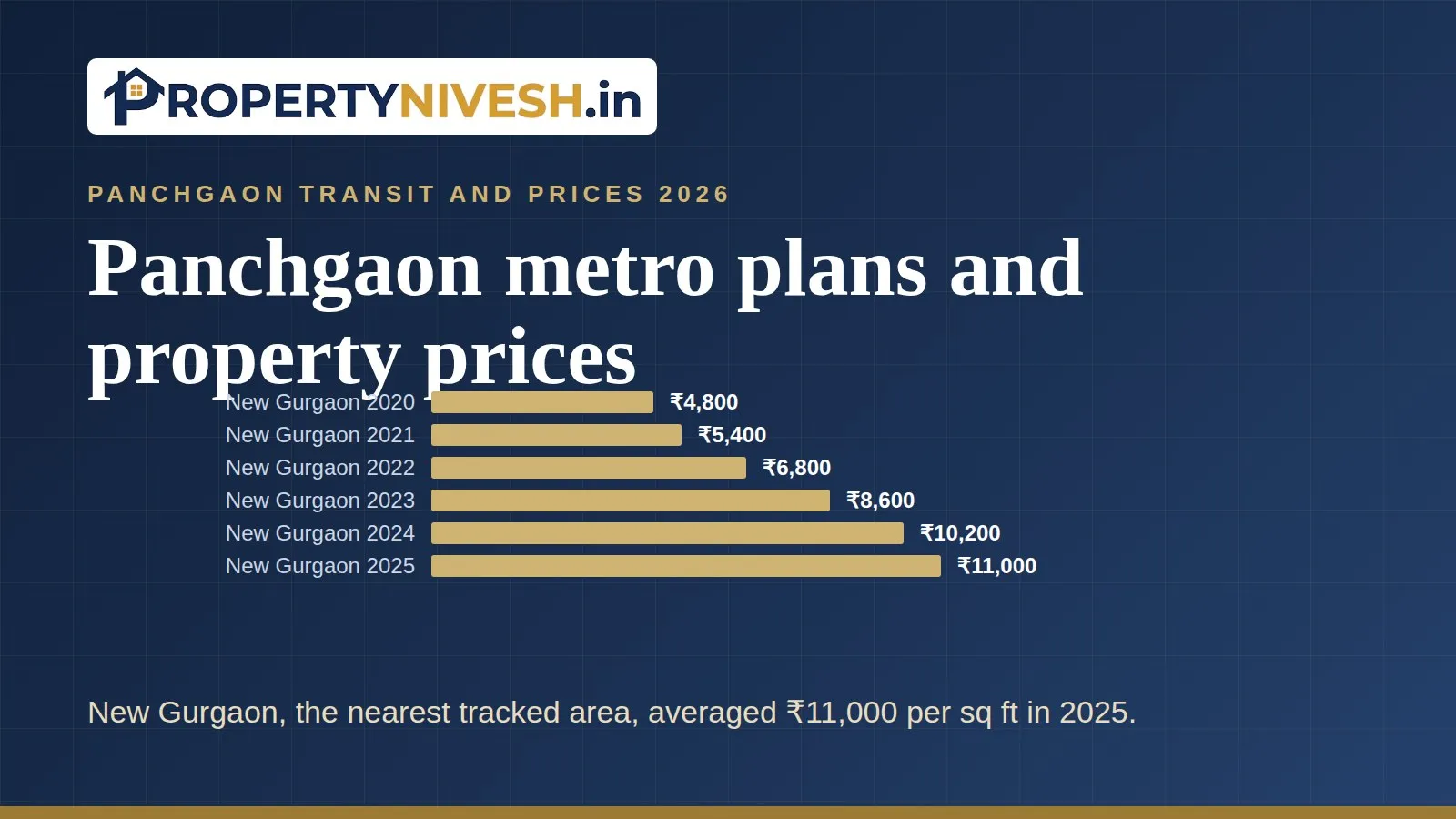
Over 2020 to 2025, Dwarka Expressway's average asking price rose 159.6%, from ₹5,200 to ₹13,500 per sq ft. New Gurgaon rose 129.2% and Golf Course Road 120.7% over the same years. The area with the big new road rose most, but we can't say how much of that came from the road.
Station-area rules add another twist, and again this is general reasoning. Extra building rights near stations can lift what land is worth to a developer. They can also bring many new flats close by, which may slow resale gains for existing homes.
What do official values show near Panchgaon today?
They're mixed, and none is for Panchgaon itself. Our Gurugram collector-rate lists have no Panchgaon line, so the table uses Manesar tehsil and named lines close to the rail plans.
A collector rate is the minimum value the district sets for registering a sale. Stamp duty is charged on it or on the price, whichever is higher.
| Line in the collector-rate list | Tehsil list | Change, 2025-26 to 2026-27 | Change, 2024-25 to 2026-27 |
|---|---|---|---|
| Residential plots, median across the tehsil (60 and 40 areas) | Manesar | 0.7% | 10.9% |
| Kherki Daula, residential plot | Manesar | 25.2% | Not available |
| Kherki, residential plot | Manesar | 0.7% | Not available |
| Manesar, residential plot | Manesar | 25.3% | 37.8% |
| Sector 1 IMT Manesar, independent floors | Manesar | 14% | 14% |
| HUDA sectors M9, M10, M12, M12A, M13 and M14, residential plot | Harsaru | 30% | Not available |
Source: Gurugram collector rate lists, Property Nivesh research store. We publish percentage changes only.
Kherki Daula matters here because it's the station listed just before Panchgaon in the 2018 RRTS list. Its line rose 25.2% in the latest list, while a separate line labelled Kherki rose 0.7%. Ask the tehsil office which line applies to a given khasra (land parcel).
Collector rates are set by the district and don't record why they change, so they can't prove a transit effect. They're a floor for registration, not a market price. For a fuller read on the area, see property rates in Manesar.
What does New Gurgaon's price tracker suggest for the Panchgaon belt?
It gives a direction, not a Panchgaon price. New Gurgaon is the nearest area we track, and the planned metro is meant to improve its links, so it's a fair proxy. Our tracker covers sectors 76 to 95 along NH-48 and reports average asking prices per sq ft, mostly for flats.
The chart shows New Gurgaon's yearly average asking price from 2020 to 2025, with our forecast to 2030. Prices went from ₹4,800 per sq ft in 2020 to ₹11,000 in 2025, a rise of 129.2%. But the pace slowed to 7.8% in 2025, from 18.6% in 2024 and 26.5% in 2023.
Our base case reaches ₹15,300 per sq ft by 2030, with a low case of ₹13,000 and a high case of ₹16,000. Growth starts at the area's latest yearly change. It then moves in equal steps to a long-run pace of 6.1% a year, reaching it in year five.
That long-run pace is the average yearly rise in NHB RESIDEX's 50-city index over the 8 quarters from 2024-Q3 to 2026-Q2. The figures come from NHB press releases. The low case halves the base-case growth, and the high case holds the faster of the two paces for five years. It's a projection, not investment advice, and it says nothing about Panchgaon land.
Plots in this belt are priced per gaj (1 gaj is 1 square yard, or 9 sq ft). So treat the flat figures as direction only. The New Gurgaon price tracker has the latest numbers.
What is the risk of buying near Panchgaon on a metro announcement?
The risk is paying today for a benefit that may arrive late, change shape or not arrive at all. Here's what our records flag:
- Sanction isn't in place. The RRTS DPR has state approvals from 2019 and a revised version from April 2025. The Union Cabinet's 2026 decisions, up to 6 October, include no approval for it.
- Plans change shape. The 2018 DPR says 106 km, while a later NCRTC document gives 118 km for a Delhi-Gurugram-Neemrana first phase. Another lists a tentative 196 km Delhi-Alwar line, and the route has been revised.
- Costs move. Gurugram's metro now under construction was sanctioned at ₹5,452.72 crore. In May 2026, Haryana approved a revised ₹10,266.54 crore, and we found no Union approval of that figure.
- Station rules aren't final. The TOD (transit-oriented development) zone split for RRTS station areas is still pending, as our note on Gurugram RRTS TOD status explains.
- Sales talk runs ahead. When the Delhi-Faridabad-Sohna expressway spur ran trials in October 2026, our news desk warned that sellers might quote trial travel times. Our note on the expressway's final stretch suggests asking for proof of real times.
Land bought on a plan also earns no rent while it waits. Our property appreciation calculator lets you try different growth rates and holding periods. That shows what a few extra years of waiting do to the result. For the area's own outlook, see our Manesar land price prediction.
Before you buy near Panchgaon for metro access: what to check
Check the plan, the distance and the paper, in that order:
- Sanction. Look in the Press Information Bureau's Union Cabinet decisions for the Delhi-Gurugram-SNB (or Delhi-Bawal) Namo Bharat corridor.
- Metro steps. Check Haryana government press notes for a cost, tender or contract award on the Sector-56 to Panchgaon metro.
- Station site. Ask the seller to show the station on the latest official alignment, then measure the walk yourself.
- TOD status. Wait for DTCP's list of TOD stations and zones before paying extra for "TOD land".
- Collector rate. Ask the sub-registrar which line covers the khasra, and compare the asking price with it.
- Real deals. Ask for registered sale deeds nearby, not just asking prices.
- Land use and title. Check the Town and Country Planning Department's development plan, the land record and any HRERA registration. HRERA is the Haryana Real Estate Regulatory Authority.
- Holding cost. Work out how long you can wait without the land earning anything.
Our stamp duty calculator covers the cost of registering a purchase. For the full investment case and its risks, read Panchgaon property investment potential.
Questions
Frequently Asked Questions
Will the metro raise property prices in Panchgaon? +
It may, but there's no way to measure it yet. The Sector-56 to Panchgaon metro and the Namo Bharat RRTS were still plans in our records in October 2026. In general, prices near transit firm up most once trains run, and mainly within walking distance of a station. That's general reasoning, not our own finding.
What are property prices near Panchgaon today? +
We don't track Panchgaon. The nearest tracked area, New Gurgaon (sectors 76 to 95), averaged ₹11,000 per sq ft in asking prices in 2025, mostly for flats. That's a proxy, not a Panchgaon price. Plots are priced per gaj, and Manesar tehsil's median plot collector rate rose 0.7% in the latest list.
How fast would the Namo Bharat RRTS be from Panchgaon to Delhi? +
We don't have a Panchgaon to Delhi time. Swarajya reported in October 2026 that the corridor could bring Delhi to Bawal within about 67 minutes, and Panchgaon was listed before Bawal in the 2018 station list. Actual times depend on the final route, stops and service, none of which is fixed yet.
Do collector rates rise when a metro is announced? +
Our data can't show that. Collector rates are set by the district each year, and the lists don't record why they change. Near Panchgaon, the Kherki Daula line rose 25.2% in the 2026-27 list, while Manesar tehsil's median plot rate rose 0.7%. Treat any link to transit as unproven.
How long does a Gurugram rail project take from approval to opening? +
Years, going by our records. Gurugram's current metro had its DPR approved by Haryana in August 2020 and by the Union Cabinet in June 2023. Construction started in September 2025, and progress was about 11% by June 2026. The Panchgaon RRTS hasn't reached Union approval yet, a step that metro passed in 2023.
Sources
- Haryana Mass Rapid Transport Corporation board meeting, Haryana government press note, 30 December 2025
- NCRTC release on approval of the Delhi-Gurugram-SNB RRTS DPR, 6 December 2018, and later NCRTC and Press Information Bureau records to 6 October 2026, via Property Nivesh research store
- Dwarka Expressway statements via Press Information Bureau, 4 March 2021, 11 July 2022 and 18 May 2023, and inauguration of the Haryana section, 11 March 2024, via Property Nivesh research store
- Gurugram Metro costs: Union sanction via PIB, 2023, and Haryana Cabinet revised cost, 18 May 2026; progress via Haryana press release, 21 July 2026; via Property Nivesh research store
- Gurugram collector rate lists 2024-25, 2025-26 and 2026-27, Property Nivesh research store (percentage changes only), October 2026
- Property Nivesh price tracker and forecast, New Gurgaon, Dwarka Expressway and Golf Course Road, October 2026 (forecast method uses NHB press releases)
- Swarajya and ET Infra on NCRTC approval expectations, via Property Nivesh news, 19 October 2026
- Hindustan Times on TOD status for Gurugram RRTS stations, via Property Nivesh news, 29 September 2026
- The Times of India on the Delhi-Faridabad-Sohna corridor trials, via Property Nivesh news, 20 October 2026