
Buying Guides
Land Near KMP Expressway for Investment: What to Check First
Our records hold no route, opening date or traffic figure for the KMP Expressway, only two junction records, so we can't tell you which parcels are near it. Before you buy land beside any expressway, confirm the real access point, the land use and CLU, any acquisition notice, the title records and the collector rate.
 By Rajan Khosla · Edited by
Rakesh Mahajan · · 10 min read
What do we know about the KMP Expressway?
Very little, and it's better to say so up front. Our records hold no route, length, opening date or traffic count for the Kundli-Manesar-Palwal (KMP) Expressway. Its name gives its three ends, Kundli, Manesar and Palwal, and that's as far as our own data goes on where it runs.
The road does appear in two of our infrastructure records, both at junctions:
- The Delhi-Mumbai Expressway has a cloverleaf interchange with the KMP at Khalilpur village in Nuh district, according to the Bharatmala booklet cited in our record. The expressway's Delhi-Dausa-Lalsot section opened on 12 February 2023.
- Package 3 of the Delhi-Faridabad-Sohna spur runs from the Sector 62/65 road in Faridabad to the KMP Expressway junction. A Lok Sabha reply of 13 March 2025 listed it as completed, but we hold no opening date for it.
News reports add a little. The Tribune reported on 3 October 2026 that drivers from Gurugram can reach the Delhi-Amritsar-Katra Expressway network through the Dwarka Expressway or the KMP. Our note on the faster Gurugram-Amritsar drive covers the report. That's useful context. It still doesn't tell you which villages or sectors the road passes.
So when a broker calls a parcel "KMP-facing", treat it as a claim you need to check yourself. The rest of this guide shows you how.
Does land beside an expressway get access to it?
Not always, and this is the first thing to settle. Many expressways are access-controlled, which means vehicles can join or leave only at interchanges. A plot can sit right beside the carriageway and still be a long, slow drive from the nearest entry point.
Our records describe the Dwarka Expressway and the Delhi-Faridabad-Sohna spur as access-controlled. We hold no design record for the KMP itself, so don't assume either way. Ask these questions on site:
- Where is the nearest interchange or exit, as shown in the road agency's own plan and not on a sales map?
- Is there a service road along the expressway, and does it reach your parcel?
- Is the approach a public road, or a revenue rasta (a path marked on the village revenue map) that neighbours could dispute?
- Will a boundary wall, a drain or a noise barrier block the frontage you're paying for?
Then drive the route yourself at peak hour. We hold no distances or travel times for these roads, so we can't measure it for you, and you shouldn't rely on a brochure's figure.
What do the collector lists say about road-frontage land?
They value road-side farmland on its own lines, and those lines rose in the 2026-27 lists. A collector rate is the minimum value Haryana sets for registering a property deed. It isn't a market price, and we publish only its percentage changes.
The Farrukhnagar and Pataudi tehsils are the useful ones here. A tehsil is a revenue sub-division of the district, with its own registry office. Both lists print separate lines for farmland within 2 acres of a road. None of those lines names the KMP Expressway. We searched the road lines in both lists for KMP, Kundli, Manesar, Palwal and Expressway and found no match.
| Line in the 2026-27 list | Tehsil | Lines compared | Median change | Range |
|---|---|---|---|---|
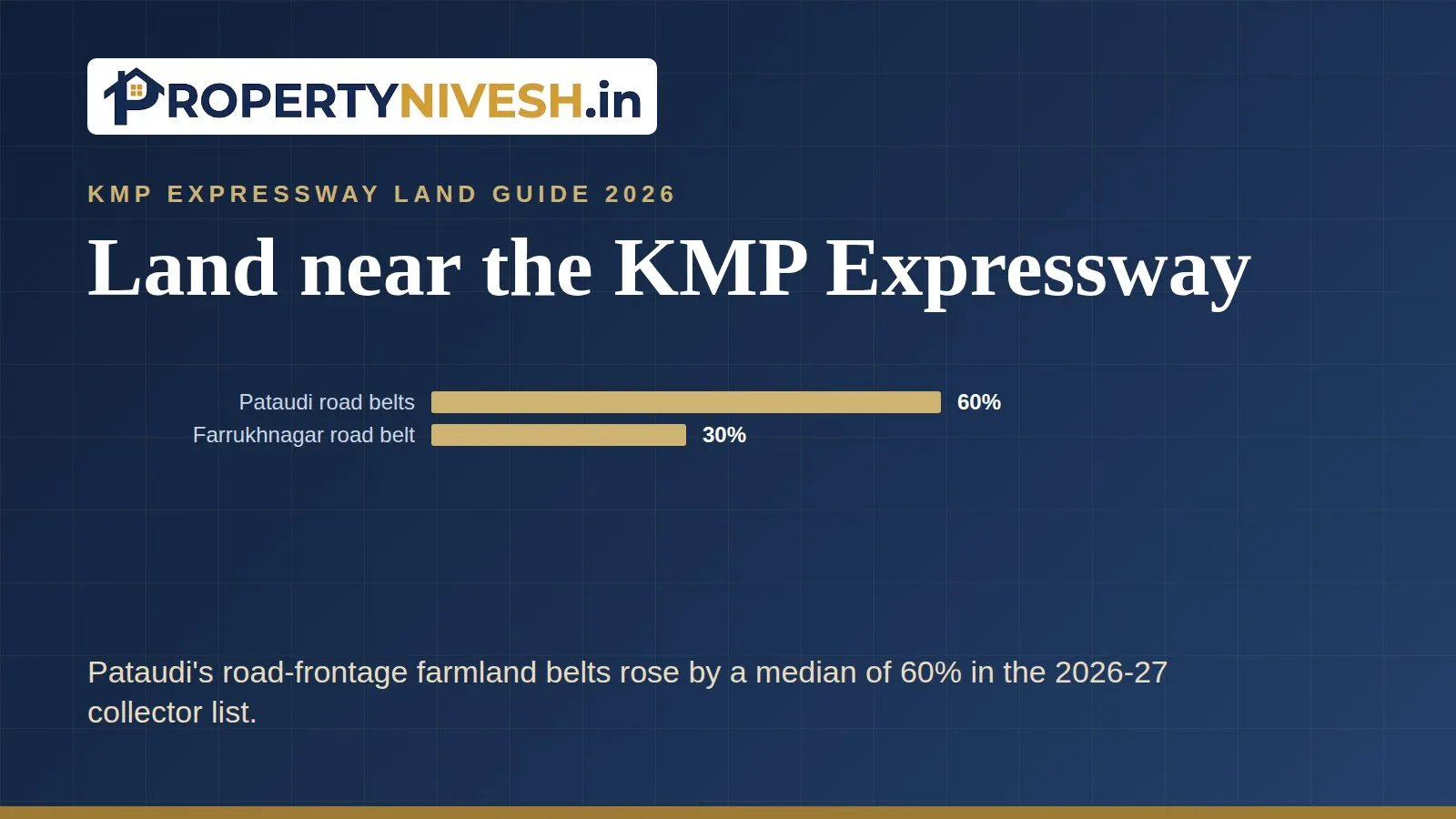
| "2 Acre From Road" farmland belt | Farrukhnagar | 64 | 30% | 0% to 75% |
| State highway, SH MDR and NH-8 belts within 2 acres | Pataudi | 22 | 60% | 0% to 75% |
| All farmland lines, per acre | Farrukhnagar | 99 | 30% | 0% to 75% |
| All farmland lines, per acre | Pataudi | 95 | 60% | 0% to 75% |
The changes run from the old 2025 rate to the final 2026 rate, and cover only the lines that passed our validation check. At the median, the road belts moved in step with each tehsil's farmland as a whole.
The lists also print standing road premiums. Farrukhnagar values land on a National Highway or the NPR 20% above normal, up to 2 acres deep. NPR means the Northern Peripheral Road, the Haryana stretch now called the Dwarka Expressway. Pataudi adds 25% for land on NH-8, and 10% for land on the Pataudi-Bilaspur-Tauru road or the Pataudi-Rewari road, also up to 2 acres deep.
For the belts village by village, see our guide to the best areas to buy land near the KMP Expressway.
Why does the collector rate matter in a land deal?
Because it sets the floor for your stamp duty. In Haryana, duty is charged on the sale price or the collector value, whichever is higher. The rate is 7% for men and 5% for women. The registration fee goes up to ₹50,000, as IANS reported via NewKerala on 28 July 2026.
So a rise in the collector rate lifts your minimum tax, even if you negotiate a low price. If a belt's collector value rises 60%, the minimum duty on it rises 60% too, because duty is a fixed share of that value. You can run your own numbers in our stamp duty calculator.
The lists also price converted land at a multiple of the farm rate. CLU, or change of land use, is the state's permission to use farmland for something other than farming. Both lists value CLU land at 2 times the agricultural rate for a warehouse, industrial or institutional use. It's 3 times for a residential plotted colony, 4 times for group housing and 5 times for commercial use.
That's why land that already has CLU carries a much higher registration floor. A man paying 7% on land valued at 2 times the farm rate pays duty equal to 14% of the plain farm value (7% times 2). Rates can differ for land outside municipal limits, so confirm the rate for your deed with the sub-registrar.
What can you build on farmland near a highway?
Nothing beyond farm use until the land use is changed. In Haryana, farmland in a controlled area (a belt around towns where building is regulated) needs CLU from the Department of Town and Country Planning (DTCP). Only then can it host homes, shops, a warehouse or a factory.
Whether CLU is even possible depends on the development plan. That's the official land-use map for a town and its surroundings, showing residential, industrial, agricultural and green zones and the planned roads. Land shown in the agriculture zone, or in a green belt beside a road, may never get the use you have in mind.
Ask DTCP these three things before you pay a token amount:
- Which development plan covers the khasra (the field's number on the revenue map), and which zone is it in?
- Is there a building line or a no-construction strip along the road that cuts into the usable area?
- Has CLU been granted on this land before, and is that grant still valid?
Our guide on Farrukhnagar land investment covers the town and the tehsil in more detail, including what land buyers there must check.
How do you check for land acquisition near a new road?
Ask the tehsil, and search the official gazette for your khasra numbers. New roads, interchanges and service lanes need land, and the government acquires it through public notices. A parcel under notice can be hard to sell, and the compensation may not match what you paid.
Our news desk covered a sharp example on 3 October 2026. As reported, the Enforcement Directorate's searches linked to the TDI Group stem from a CBI case over land in Manesar, Naurangpur and Lakhnoula villages. The agency alleges that more than 400 acres notified for acquisition was bought cheaply from farmers. Read our note on the TDI Group searches for what it means for buyers.
Also check whether the land sits in a strip kept for widening, a new junction or a utility line. The road agency's plan and the development plan both show reserved strips that a seller may not mention.
Which land records should you see before you pay?
Start with the jamabandi, the mutation entries and the khasra details, then get the land measured. These are Haryana's basic revenue records, kept by the patwari (the village record keeper) and the tehsil.
- Jamabandi: the record of rights. It shows who owns the land, each owner's share, and who farms it.
- Mutation: the entry that records a change of owner after a sale, gift or inheritance. Check that every past sale has a sanctioned mutation.
- Khasra: the field number on the village map. Match it to the land you see on the ground.
- Demarcation: a measurement by revenue staff that fixes the boundary. Ask for it before the sale deed, not after.
Watch for shared ownership too. If the jamabandi lists several owners on one khewat (the owners' holding), a seller may own only an undivided share, not a marked plot.
If the online record doesn't match the manual one, Haryana now has a tehsil-level fix, as our note on the land record correction module explains. Don't pay until any mismatch is sorted out.
Before you buy land near the KMP Expressway: what to check
Use this list in order. Each step is cheaper than the mistake it prevents.
- Ask the seller which junction or interchange they mean, then confirm it in the road agency's plan.
- Visit, find the actual entry point, and drive it at peak hour.
- Check the development plan zone and any building line along the road with DTCP.
- Get it in writing whether CLU exists, or is possible, for the use you want.
- Search for acquisition notices against the khasra numbers.
- Collect the jamabandi, the mutation copies and a demarcation report.
- Find the collector rate line for the village and belt, and work out the stamp duty.
- Have a lawyer read the chain of title before any token payment.
For the price question, read our explainer on the KMP Expressway's impact on property prices. For the road records around Pataudi, see upcoming highways near Manesar and Pataudi. And for flat prices across the city, our Gurgaon property rates page tracks six localities.
Questions
Frequently Asked Questions
Is land near the KMP Expressway a good investment? +
Our data can't answer that for any parcel. We hold no route, opening date or traffic record for the KMP Expressway, and no collector line names it. What we can show is that road-frontage farmland belts rose by a median of 30% in Farrukhnagar and 60% in Pataudi in the 2026-27 lists. Judge each parcel on access, land use and title.
Which villages are on the KMP Expressway? +
We can't name any. Our records mention the KMP only at two junctions: its interchange with the Delhi-Mumbai Expressway at Khalilpur village in Nuh district, and the end of the third package of the Delhi-Faridabad-Sohna spur. To check a village, look at the road agency's alignment plan and the DTCP development plan for that area.
Does road-frontage land get direct access to an expressway? +
Not on an access-controlled road. Vehicles can join only at interchanges, so a parcel beside the carriageway may still need a long detour. Check for a service road, find the nearest official entry point in the road agency's plan, and confirm that the approach is a public road rather than a disputed revenue path.
What is CLU and do I need it for land near a highway? +
CLU, or change of land use, is permission from Haryana's Department of Town and Country Planning to use farmland for something other than farming. In a controlled area you need it before building homes, shops, a warehouse or a factory. Whether you can get it depends on the land's zone in the development plan.
How is stamp duty worked out on land in Gurugram district? +
Haryana charges stamp duty on the sale price or the collector value, whichever is higher. The rate we hold is 7% for men and 5% for women, with a registration fee of up to ₹50,000, as IANS reported via NewKerala on 28 July 2026. Confirm the rate for your deed with the sub-registrar before you register.
Sources
- Property Nivesh infrastructure records: Delhi-Mumbai Expressway, Delhi-Dausa-Lalsot section (NHAI, PIB, Bharatmala booklet) and Delhi-Faridabad-Sohna spur (NHAI lists, Lok Sabha reply of 13 March 2025), status as of 9 October 2026
- Gurugram collector-rate lists 2026-27, Farrukhnagar and Pataudi tehsils, percentage changes and printed road rules extracted by the Property Nivesh research store, October 2026
- The Tribune, report on NCR expressway links to the Delhi-Amritsar-Katra Expressway, 3 October 2026, via Property Nivesh news
- Hindustan Times and The Tribune, reports on ED searches linked to the TDI Group, October 2026, via Property Nivesh news
- Hindustan Times, Haryana revenue record correction module, 3 October 2026, via Property Nivesh news
- IANS via NewKerala, Haryana stamp duty and registration fee, 28 July 2026