
Investment Guides
Farrukhnagar Warehouse Land Investment: Data, CLU and Checks
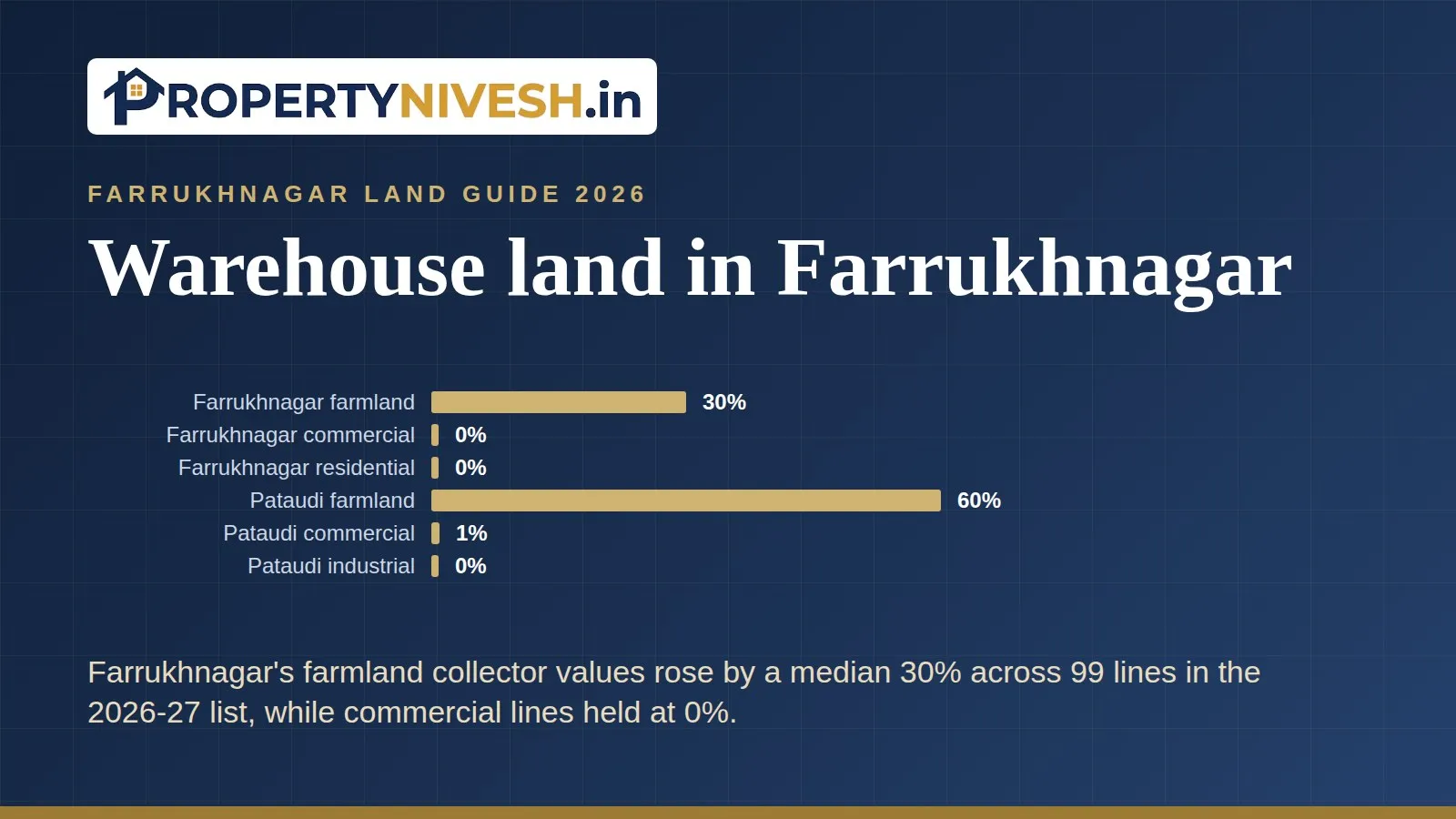
We hold no warehouse rents, yields or land deals for Farrukhnagar, so we can't say whether warehouse land there pays. What we can show is that its 2026-27 collector list raised farmland by a median 30% across 99 lines while commercial and residential lines held at 0%, and that a warehouse on farmland needs change of land use (CLU) before anything is built.
 By Akansha Singh · Edited by
Rakesh Mahajan · · 9 min read
Is Farrukhnagar land a good bet for a warehouse?
Our data can't tell you, because we hold no warehouse rents, yields, occupancy or land deals for Farrukhnagar. What we do hold is the official collector list for the tehsil, our freight corridor records and HRERA project records. This guide sets those out and lists the permissions a warehouse needs.
Keep in mind that most of what makes a warehouse site work isn't in a collector list. Trucks need a road they can use all year, the site needs power, and the permission must match the use. Rents come from tenants, and we hold no tenant data. So read the numbers below as the official side of the story only.
First, a naming point. Farrukhnagar town has its own Sectors 1 and 3 in HRERA records. Farrukhnagar tehsil is the wider revenue area around it, with its own collector list. A tehsil is a revenue sub-division of the district, with its own registry office. Official records also spell the name "Farukhnagar".
If you're new to the area, start with our hub on Farrukhnagar land investment near Gurgaon, then come back here for the warehousing questions.
What land types does the Farrukhnagar collector list show?
Farmland, commercial and residential lines, but no industrial lines in the text we could extract. Only farmland moved much in the 2026-27 list. A collector rate is the minimum value Haryana sets for registering a deed, not a market price, and we publish only its percentage changes.
| Land type | Unit | Lines | Lines validated | Median change | Range | Share unchanged |
|---|---|---|---|---|---|---|
| Agricultural | per acre | 115 | 99 | 30% | 0% to 75% | 21.2% |
| Commercial | per sq yd | 48 | 45 | 0% | 0% to 30% | 62.2% |
| Residential | per sq yd | 52 | 48 | 0% | 0% to 15% | 91.7% |
| Industrial | none found | 0 | 0 | n/a | n/a | n/a |
Share unchanged is the share of validated lines that didn't move at all. The changes run from the old 2025 rate to the final 2026 rate. Farrukhnagar's list is hard to read, so we count only lines that passed our validation check. Its 2025-26 list is an unreadable scan, which means we can't show a longer trend.
The chart compares Farrukhnagar and Pataudi by property type in the 2026-27 list. Pataudi's farmland rose by a median 60% across 95 lines, its commercial and residential lines by 1% each across 102 lines, and its single industrial line didn't change.
Flat commercial values aren't unusual. In the latest lists, the commercial median was 0% in Badshahpur, Harsaru, Kadipur and Sohna, 0.1% in Gurugram and 0.6% in Manesar. Wazirabad, at 25%, was the exception.
How does the collector list value land with warehouse CLU?
At twice the farmland rate. CLU, or change of land use, is the state's permission to use farmland for something other than farming. Both the Farrukhnagar and Pataudi lists print the same multiples for land that has CLU:
- Warehouse, industrial or institutional use: 2 times the agricultural rate.
- Residential plotted colony: 3 times.
- Group housing: 4 times.
- Commercial: 5 times.
This matters for your costs. Haryana charges stamp duty on the price or the collector value, whichever is higher. At the 7% rate for men, duty on land valued at 2 times the farm rate works out to 14% of the plain farmland value (7% times 2). Rates can differ for land outside municipal limits, so confirm the rate for your deed with the sub-registrar. At the 5% rate for women it's 10% (5% times 2). Check your own figures in our stamp duty calculator.
Road frontage adds more. Farrukhnagar's list values land on a National Highway or the NPR 20% above normal, up to 2 acres deep. NPR is the Northern Peripheral Road, the former name of the Haryana stretch of the Dwarka Expressway. The list also values land in what it calls the Farrukhnagar R-Zone at two times the farm rate. Its "2 Acre From Road" farmland belt rose by a median 30% across 64 lines.
Which freight corridors are on our records?
Two freight records and one industrial corridor programme. None of them names Farrukhnagar, and we hold no distance from Farrukhnagar to any station on them.
| Record | Status in our records | Key dates on record |
|---|---|---|
| Western Dedicated Freight Corridor (WDFC) | Operational | Cost estimate of ₹81,459 crore approved in June 2015; New Rewari to New Madar opened in January 2021; trial runs on the last stretch, JNPT to New Saphale, on 31 March 2026 |
| WDFC New Rewari to New Dadri section | Operational | Goods train ran from ICD Dadri to New Rewari on 31 March 2023; Trucks-on-Trains from New Rewari since August 2021 |
| Delhi-Mumbai Industrial Corridor (DMIC) | Partially operational | Approved in 2007 with the WDFC as its backbone; the Haryana node listed is the Manesar-Bawal Investment Region |
The WDFC is freight-only, so its value to property is about logistics, not commuting. The NCR stretch in our record names New Rewari, Prithala and New Dadri. A corridor helps a warehouse site only if trucks can reach a terminal easily, and we can't measure that for any Farrukhnagar parcel.
For the full story on these programmes, including IMT Manesar and Global City, read our guide to upcoming industrial corridors near Gurgaon.
What permissions does a warehouse on farmland need?
At the least, a zone that allows it and CLU from the Department of Town and Country Planning (DTCP). Treat the steps below as the questions to ask, and get the current rules from DTCP itself:
- Zone: check the development plan, the official land-use map for the town and its surroundings. It shows where industrial, warehousing and agricultural uses sit, and which roads are planned.
- CLU: apply to DTCP. A grant comes with conditions, such as setbacks and the approach road the site must have.
- Building plans: get them approved before you build anything.
- Safety and pollution: plan for fire safety clearance, and consent from the Haryana State Pollution Control Board where the use needs it.
A bigger project works differently. An estate divided into plots for sale needs a DTCP licence, the permission a developer gets to build a colony, and an HRERA registration. HRERA is the Haryana Real Estate Regulatory Authority, where projects must register before sale.
What do HRERA records show for Farrukhnagar and industrial plots?
Every Farrukhnagar town record that states a category is residential. Industrial plotted colonies do appear on HRERA, but elsewhere in the district. Our records run to 14 September 2026.
- Farrukhnagar town: 12 projects. Seven filed plots, three filed homes (flats or floors), and two 2017 records give neither. Ten were registered since 2021, and none has lapsed. None is filed as a commercial, industrial or warehousing project.
- Daxin Gurugram's X Factor: an industrial plotted colony in villages Bhondsi, Ghamroj and Mahendwara, Sohna, registered on 20 September 2024 with 945 plots on 125.6 acres.
- City of Colours NH-8: an industrial plotted colony in village Sidhrawali, registered on 7 October 2024 with 1,058 plots on 129.66 acres.
Our project page for Signature Global City of Colours describes a mix of residential, industrial and commercial plots under licence 104 of 2024. A registration isn't a quality rating, but it does tell you the project went through the formal route.
What are the risks in a warehouse land deal?
The biggest risk is buying farmland on a promise of use it may never get. Watch for these:
- "Warehouse-ready" claims without CLU. Without the permission, the land is still farmland, and a shed built on it can face action.
- A zone that doesn't allow it. Land in a green belt or a strip kept for a road may never get CLU.
- Weak access. A narrow village lane or a disputed revenue rasta (a path on the revenue map) can sink a CLU application.
- Unknown demand. We hold no rent or occupancy data, so test any rent quote against signed leases you can see.
- Title gaps. Shared ownership, missing mutations or an acquisition notice can block a sale or a loan.
Our guide to agricultural land near Gurgaon for investment covers what farmland can and can't be used for, and the records to check.
What to check before buying warehouse land in Farrukhnagar
Work through this list before any token payment:
- Get the village name and khasra numbers (field numbers on the revenue map).
- Check the zone in the DTCP development plan, and ask whether warehousing is allowed there.
- Ask DTCP whether CLU has been granted, applied for or refused on the land.
- Confirm the approach road on the revenue map and on site.
- Collect the jamabandi (record of rights), the mutation entries and a demarcation report.
- Ask the tehsil about acquisition notices against the khasras.
- Find the collector line for the village, and work out duty on the collector value with any CLU multiple.
- Test any rent figure with real leases, then run it through our rental yield calculator.
For how expressway frontage and access affect a land deal, see our checklist for land near the KMP Expressway. For tracked flat prices across the city, our Gurgaon property rates page covers six localities.
Questions
Frequently Asked Questions
Can I build a warehouse on agricultural land in Farrukhnagar? +
Not without permission. Farmland needs change of land use (CLU) from Haryana's Department of Town and Country Planning before it can host a warehouse, and the zone in the development plan must allow that use. You'll also need approved building plans and the safety clearances the use requires. Check all of this before you pay.
What are warehouse rents or yields in Farrukhnagar? +
We don't know, and we don't publish a figure. We hold no warehouse rents, yields, occupancy or land deals for Farrukhnagar. If a seller quotes a rent, ask to see signed leases for similar sheds nearby, then test the numbers yourself in a rental yield calculator before you treat them as real.
How did Farrukhnagar's collector rates change in 2026-27? +
In the 2026-27 list, farmland rose by a median 30% across 99 validated lines. Commercial lines held at a 0% median across 45 lines, and residential lines at 0% across 48 lines. We found no industrial lines in the text we extracted. These are official minimum values for registration, not market prices.
Is Farrukhnagar on the Western Dedicated Freight Corridor? +
Our records don't say so. The WDFC record names New Rewari, Prithala and New Dadri on its NCR stretch, and the Rewari-Dadri section has run since 31 March 2023. None of our freight records names Farrukhnagar, and we hold no distances, so check the nearest terminal and the truck route yourself.
How is land with warehouse CLU valued for stamp duty? +
The Farrukhnagar and Pataudi collector lists value land with warehouse CLU at two times the agricultural rate. Stamp duty is charged on the price or the collector value, whichever is higher. At 7% for men, that works out to 14% of the plain farmland value, and at 5% for women, 10%.
Sources
- Gurugram collector-rate lists 2026-27, Farrukhnagar and Pataudi tehsils, percentage changes by property type and printed valuation rules extracted by the Property Nivesh research store, October 2026
- Gurugram collector-rate lists by tehsil, commercial lines, 2025-26 to 2026-27, Property Nivesh research store, October 2026
- Property Nivesh infrastructure records: Western Dedicated Freight Corridor and WDFC New Rewari to New Dadri section (DFCCIL, CCEA), Delhi-Mumbai Industrial Corridor (NICDC, PIB), status as of 9 October 2026
- HRERA Gurugram registered projects, records to 14 September 2026, via Property Nivesh research store
- IANS via NewKerala, Haryana stamp duty and registration fee, 28 July 2026