
Investment Guides
Agricultural Land Near Gurgaon for Investment: Rates, Rules, Risks
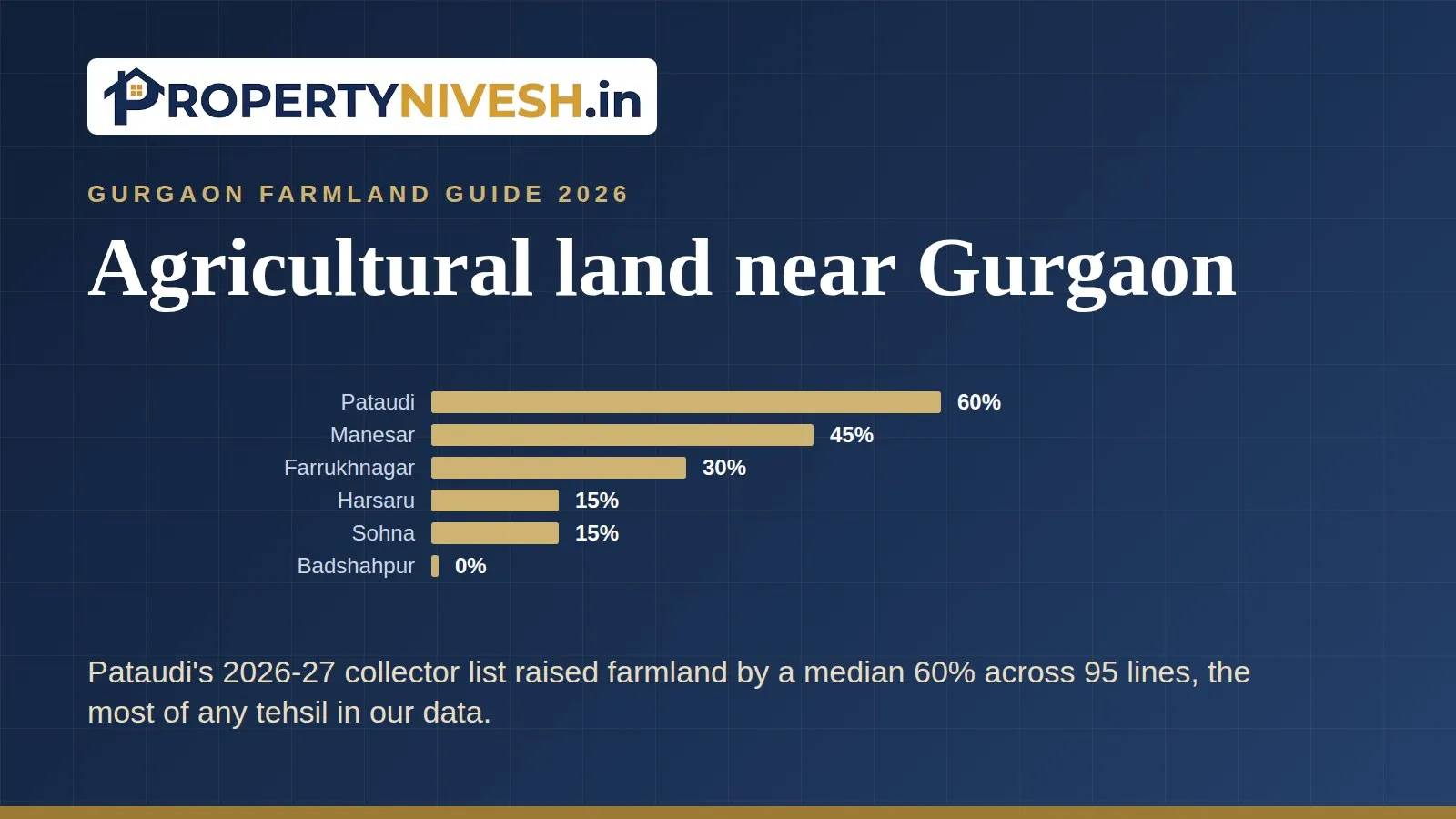
Official farmland values rose most in Pataudi (median 60% across 95 lines), Manesar (45%) and Farrukhnagar (30%) in the latest Gurugram collector lists, and didn't move in four other tehsils. Farmland near Gurgaon can only be farmed until the state grants change of land use, so the land's zone and title matter more than any rate rise.
 By Rahul Mishra · Edited by
Rakesh Mahajan · · 9 min read
Is agricultural land near Gurgaon a good investment?
That depends less on the rate trend than on the title and what the land is allowed to become. Official farmland values rose most in Pataudi, Manesar and Farrukhnagar in the latest lists, and didn't move in four other tehsils. Farmland stays farmland until the state grants a change of land use.
We don't publish farmland prices in rupees, and we track no market price series for land. What we hold are the official collector-rate changes, the rules printed in those lists, and records of the risks buyers run into. This guide covers all three, plus the checks to make.
A tehsil is a revenue sub-division of the district, with its own registry office. A collector rate is the minimum value Haryana sets for registering a deed. It isn't a market price, and we publish only its percentage changes.
How did farmland collector rates change by tehsil?
The latest lists split the district in two. Pataudi, Manesar and Farrukhnagar rose sharply, Harsaru and Sohna rose 15%, and four tehsils didn't move at the median.
| Tehsil | Farmland lines (latest) | Latest median change | 2024-25 to 2025-26 | Two years, 2024-25 to 2026-27 (lines) |
|---|---|---|---|---|
| Pataudi | 95 | 60% | n/a | n/a |
| Manesar | 84 | 45% | 10% | 66.8% (48) |
| Farrukhnagar | 99 | 30% | n/a | n/a |
| Harsaru | 46 | 15% | 10% | 26.5% (24) |
| Sohna | 118 | 15% | 10% | 28.8% (84) |
| Badshahpur | 40 | 0% | 10% | 14.8% (30) |
| Gurugram | 24 | 0% | 10% | 51.3% (6) |
| Kadipur | 41 | 0% | 10% | 10% (15) |
| Wazirabad | 57 | 0% | 10% | 10% (36) |
For seven tehsils, "latest" means 2025-26 to 2026-27. Farrukhnagar and Pataudi have only the 2026-27 list, from the old 2025 rate to the final 2026 rate, and we count only the lines that passed our validation check. Farrukhnagar's 2025-26 list is an unreadable scan.
The chart shows the latest median farmland change by tehsil, including Farrukhnagar and Pataudi. Note the pattern in the middle column: in 2025-26, every one of the seven tehsils raised farmland by a median 10%. The big gaps opened only in 2026-27. And treat Gurugram's two-year figure with care, as it rests on just 6 lines.
Villages vary widely inside each tehsil. In both the Pataudi and Farrukhnagar lists, farmland lines ranged from no change to a 75% rise, so the median is only a starting point. Always look up the line for your own village.
For the land around New Gurgaon's sectors, see our guide to New Gurgaon land price. For Manesar's outlook, read our Manesar land price prediction.
What does a collector rate rise mean for your costs?
It raises the minimum stamp duty you pay. Haryana charges duty on the sale price or the collector value, whichever is higher. The rate is 7% for men and 5% for women. The registration fee goes up to ₹50,000, as IANS reported via NewKerala on 28 July 2026.
Because duty is a fixed share of the value, it moves one for one with the rate. If a village's farmland collector value rises 60%, the minimum duty on a deed there rises 60% too, even if your negotiated price hasn't changed.
Watch the units as well. Farmland lines are mostly priced per acre, while plot lines are priced per square yard, which buyers call a gaj. One acre is 4,840 gaj, or 43,560 sq ft. So a per-gaj price can sound small next to a per-acre one. Multiply it by 4,840 to compare like with like.
Work out your own figures in our stamp duty calculator, and add the fee using the registration charges calculator.
What can agricultural land be used for without CLU?
Farming, and not much else. In Haryana, farmland in a controlled area (a belt around towns where building is regulated) needs CLU, or change of land use, from the Department of Town and Country Planning (DTCP). Without it, the land can grow crops or orchards and stay in farm use.
Without CLU you can't legally:
- Cut the land into plots and sell them.
- Build homes, floors or flats for sale.
- Run shops, a warehouse, a factory or a banquet hall.
What's possible with permission depends on the development plan. That's the official land-use map for a town and its surroundings, showing residential, industrial, agricultural and green zones. Even a farmhouse depends on that plan's zoning rules, so ask DTCP before you assume you can build one.
Village abadi land is a separate case. Land inside the lal dora, the old settled area of a village also called abadi deh, isn't farmland. The Tribune reported on 28 November 2025 on an ordinance on ownership rights in abadi deh land outside municipal limits. Don't confuse the two when you read a listing.
How does farmland legally become plots or homes?
Through a licence or a CLU grant, and the official lists show how much value that adds. Both the Farrukhnagar and Pataudi collector lists value land with CLU at a multiple of the farmland rate: 2 times for a warehouse, industrial or institutional use, 3 times for a residential plotted colony, 4 times for group housing and 5 times for commercial use.
A colony of plots needs a DTCP licence, the permission a developer gets to build a colony, and then an HRERA registration. HRERA is the Haryana Real Estate Regulatory Authority, where projects must register before sale.
One licensed route used in towns such as Farrukhnagar and Pataudi is DDJAY, the Deen Dayal Jan Awas Yojana, Haryana's affordable plotted colony scheme. Its plots are capped at 150 sq m, about 179 gaj, under the Haryana Gazette notice of 1 April 2016. The Tribune reported on 25 April 2023 that DDJAY was dropped in the Gurugram-Manesar final development plan area and Faridabad.
So if a seller offers "plots" on farmland with no licence and no HRERA number, you're not buying into a converted colony. To see what licensed colonies look like near Pataudi Road, read our guide to approved residential colonies near Pataudi Road.
What are the risks of buying farmland near Gurgaon?
Illegal colonies top the list, followed by title gaps and acquisition. Here's what our records show:
- Illegal colonies. The Tribune reported on 12 December 2024 that plots in illegal colonies on Gurugram's edges were being sold at ₹20,000 to ₹50,000 per sq yd, and at ₹15,000 to ₹25,000 per sq yd in Behrampur. Buyers can end up with land they can't build on or sell.
- Registry holds. The Tribune reported on 10 June 2023 that registries were put on hold in about 50 illegal colonies, and the report mentioned the Section 7A NOC. Ask the tehsil whether your deed needs this no-objection certificate before it can be registered.
- Undivided shares. Farmland is often held jointly. A seller may own a share of a khewat (the owners' holding), not a marked field.
- No road on record. A field reached only by a path across a neighbour's land may have no legal access. Look for a recorded rasta on the revenue map.
- Acquisition. Land in the path of a road or an industrial estate can be notified for acquisition, so search for notices against the khasra numbers.
For a land-buyer's view of these risks in one tehsil, read is Farrukhnagar a good place to buy land?
Which land records should you check?
The jamabandi, the mutations, the khasra and the village map, all from the patwari (the village record keeper) and the tehsil. Then get the boundary measured.
- Jamabandi: the record of rights. It shows the owners, their shares and who farms the land.
- Mutation: the entry that records each change of owner after a sale, gift or inheritance. Every past sale should have a sanctioned mutation.
- Khasra: the field number on the village map, or shajra. Match it to the land on the ground.
- Girdawari: the patwari's crop record, which shows who has actually been farming the field.
- Demarcation: a measurement by revenue staff that fixes the boundary before you sign.
If the online record doesn't match the manual one, Haryana now lets tehsils fix routine errors, as our note on the land record correction module explains. Get any mismatch fixed before you pay.
Before you buy agricultural land near Gurgaon: what to check
Run through this list, in this order, before any token payment:
- Get the village, khasra numbers and khewat details from the seller.
- Read the latest jamabandi and every mutation in the chain of owners.
- Check the girdawari and the village map, then get a demarcation.
- Ask DTCP which development plan zone the land is in, and whether CLU exists or is possible for your use.
- Search for acquisition notices against the khasras.
- If it's sold as a plot, check for a DTCP licence and an HRERA number.
- Find the collector line for the village and work out stamp duty on the higher of price and collector value.
- Ask for registered sale deeds of nearby land, and have a lawyer read the title.
For tracked flat prices across the city, which give a sense of direction but aren't land prices, see our Gurgaon property rates page.
Questions
Frequently Asked Questions
Which tehsil near Gurgaon saw the biggest rise in farmland collector rates? +
Pataudi. Its 2026-27 list raised farmland by a median 60% across 95 lines. Manesar followed at 45% across 84 lines, and Farrukhnagar at 30% across 99 lines. Badshahpur, Gurugram, Kadipur and Wazirabad showed no median change. These are official minimum values for registration, not market prices.
Can I build a house on agricultural land near Gurgaon? +
Not freely. In a controlled area, farmland needs change of land use (CLU) from Haryana's Department of Town and Country Planning before it can be built on for non-farm use. Whether CLU is possible depends on the land's zone in the development plan. Even a farmhouse depends on that plan's zoning rules, so ask DTCP first.
How do I check if farmland near Gurgaon has a clean title? +
Get the jamabandi (record of rights) and every mutation entry from the patwari or tehsil, match the khasra number to the village map, and check the girdawari crop record. Ask for a demarcation of the boundary. Confirm whether the seller owns a marked field or only a share, and search for acquisition notices.
What is an illegal colony and why is it risky? +
It's a set of plots cut from farmland without a DTCP licence or HRERA registration. Buyers may be unable to register, build or sell. The Tribune reported in June 2023 that registries were put on hold in about 50 illegal colonies, and in December 2024 on a crackdown on dealers selling such plots around Gurugram.
How much stamp duty do I pay on agricultural land in Haryana? +
Duty is charged on the sale price or the collector value, whichever is higher. The rate we hold is 7% for men and 5% for women, with a registration fee of up to ₹50,000, as IANS reported via NewKerala on 28 July 2026. Confirm the rate for your deed with the sub-registrar.
Sources
- Gurugram collector-rate lists, 2024-25 to 2026-27, agricultural lines by tehsil (Badshahpur, Gurugram, Harsaru, Kadipur, Manesar, Sohna, Wazirabad), Property Nivesh research store, October 2026
- Gurugram collector-rate lists 2026-27, Farrukhnagar and Pataudi tehsils, percentage changes and printed CLU valuation rules extracted by the Property Nivesh research store, October 2026
- The Tribune, crackdown on dealers selling plots in illegal colonies, 12 December 2024
- The Tribune, registry hold in illegal colonies and Section 7A NOC, 10 June 2023
- The Tribune, DDJAY dropped in the Gurugram-Manesar final development plan area, 25 April 2023; Haryana Gazette, DDJAY plot size, 1 April 2016
- The Tribune, Abadi Deh ordinance on ownership rights outside municipal limits, 28 November 2025
- IANS via NewKerala, Haryana stamp duty and registration fee, 28 July 2026
- Hindustan Times, Haryana revenue record correction module, 3 October 2026, via Property Nivesh news