
Market Trends
Farrukhnagar Property Rates 2026: Collector Changes by Village
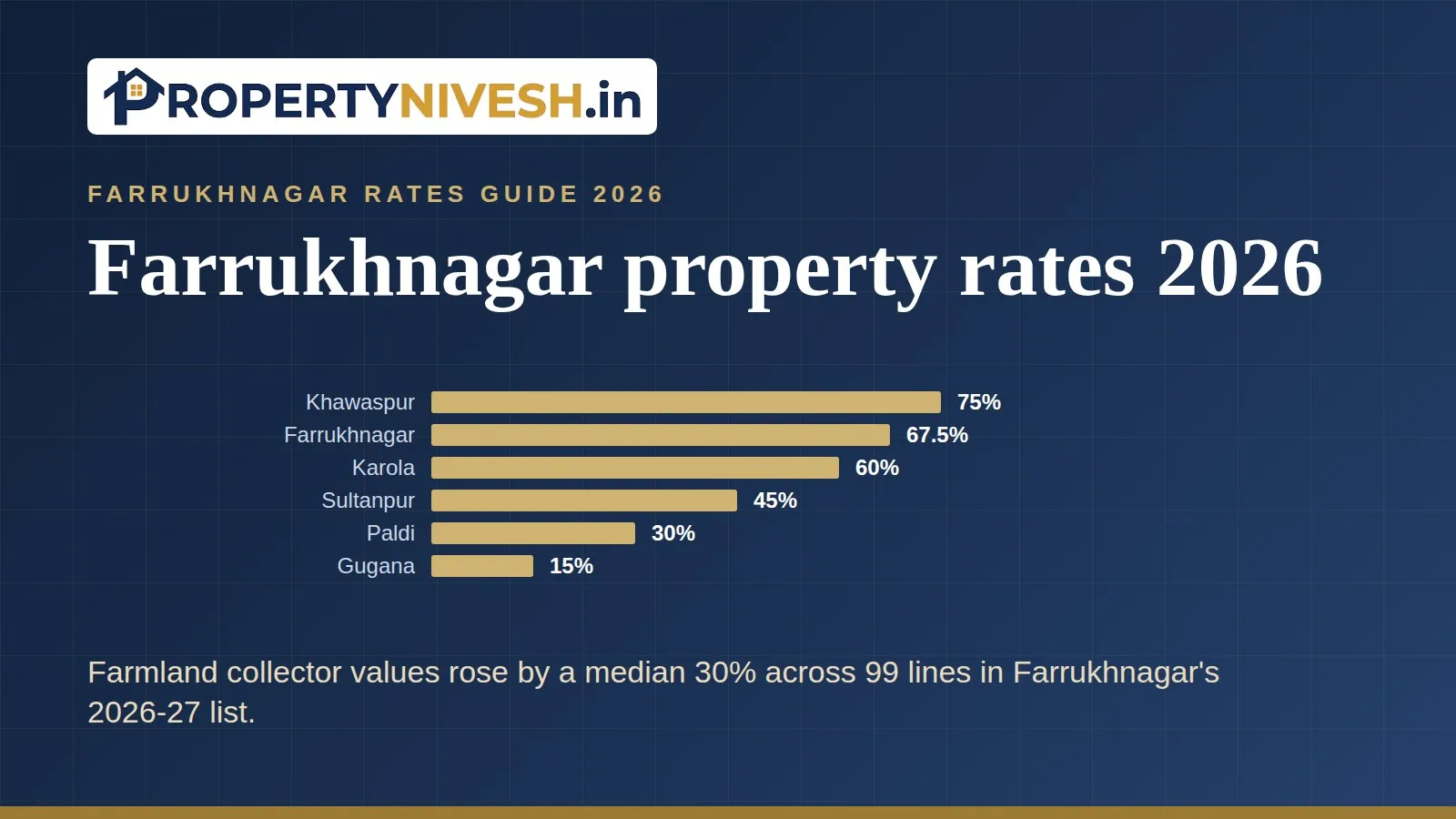
We don't publish rupee rates for Farrukhnagar, because collector rates are official minimum values for registration, not market prices, and we hold no market price series there. What the 2026-27 collector list shows is a median 30% rise for farmland across 99 lines and no change for residential or commercial lines.
 By Rahul Mishra · Edited by
Rakesh Mahajan · · 9 min read
What are Farrukhnagar property rates in 2026?
We don't publish a rupee rate for Farrukhnagar. What we can show is how the official 2026-27 collector list changed. Farmland values rose by a median 30% across 99 lines, while residential and commercial values rose by a median 0%. Collector rates are the official minimum values for registration, not market prices, and we hold no market price series for Farrukhnagar.
This post breaks those changes down by property type, by village and by road frontage. Then it explains how to find what land or a plot actually sells for. For the wider picture, start with our Farrukhnagar land investment guide.
What is a collector rate, and why isn't it the market price?
A collector rate is the lowest value at which a property deal can be registered in an area. The district administration under the Deputy Commissioner Gurugram sets it each year, line by line, for each village or colony and each type of property. Farrukhnagar is a tehsil, a revenue area of the district, and it has its own list of 40 village groups.
The rate matters because stamp duty is charged on the deal price or the collector value, whichever is higher. In Haryana that duty is 7% for men and 5% for women. So the collector rate sets the floor for your tax bill.
It isn't a market price, though. Real deals can sit above the collector value or close to it, and the list can't tell you which. A rise means the state lifted its floor; it doesn't prove that buyers paid more.
Units matter too. Farrukhnagar's list values farmland per acre and built property per square yard, which buyers call a gaj (1 gaj is 9 sq ft). One acre is 4,840 gaj, or 43,560 sq ft.
How did Farrukhnagar collector rates change by property type?
Only farmland moved in a big way. Agricultural land is land recorded for farming; residential and commercial lines cover built or plotted land where homes or shops are allowed. The table uses the official percentage changes printed in the 2026-27 list, for lines that passed our check.
| Type | Unit | Lines extracted | Lines validated | Median change | Range | Unchanged lines |
|---|---|---|---|---|---|---|
| Agricultural | Per acre | 115 | 99 | 30% | 0% to 75% | 21 of 99 |
| Residential | Per sq yd | 52 | 48 | 0% | 0% to 15% | 44 of 48 |
| Commercial | Per sq yd | 48 | 45 | 0% | 0% to 30% | 28 of 45 |
The chart compares the median change by property type in the 2026-27 lists for Farrukhnagar and Pataudi.
Pataudi's farmland rose faster, by a median 60% across 95 lines, while its residential and commercial lines rose by a median 1%. Our Farrukhnagar vs Pataudi for land investment post compares the two tehsils side by side.
A word on method. We pulled 216 lines from the list's text layer, and 192 of them matched the list's own % column to within one point. Those 192 are the lines in the table. The 2025-26 list is an unreadable scan, so this is one year of change, from the old 2025 rate to the final 2026 rate.
Which Farrukhnagar villages saw the biggest farmland changes?
The spread is wide, from 0% to 75%. The table groups the 38 village groups that have a farmland median in the 2026-27 list.
| Median farmland change | Village groups | Count |
|---|---|---|
| 75% | Khawaspur, Jhund Sarai Abad, Tajnagar, Tirpadi, Mehchana, Saidpur Mohmmadpur | 6 |
| 67.5% | Farrukhnagar, Joniawas | 2 |
| 60% | Karola, Khurrampur, Babra Bakipur | 3 |
| 45% | Iqbalpur, Garhi Nathe Khan, Jarau, Daboda, Fazilpur Badli, Sultanpur | 6 |
| 30% | Alimuddanpur, Khentawas, Jamalpur, Paldi, Faridpur, Basunda, Harinagar Dooma | 7 |
| 25% | Khandewla, Mubarikpur, one group whose name is unreadable | 3 |
| 15% | Gugana, Jurola, Bakainka | 3 |
| 7.5% | Jhanjhrola | 1 |
| 0% | Jhund Sarai Viran, Dhanawas, Birhera, Mushedpur, Rajupur, Shekhupur Mairi, Sarbashirpur | 7 |
Half-point medians such as 67.5% come from villages with an even number of lines, where the median falls between two printed figures. Two more village groups, Kaliawas and Patli Hazipur, have no validated farmland line, so they're left out.
The village group listed as Farrukhnagar carries the town's name. One HRERA record, Lykehomes Avenue, gives its address as Village Farukhnagar, Sector 3. For how these farmland changes compare across the district, see agricultural land near Gurgaon for investment.
Does road frontage change the rate in Farrukhnagar?
Often, yes. Every one of the 40 village groups in Farrukhnagar's list has a separate "2 Acre From Road" line for farmland in the belt along a road. Across 64 validated lines in that belt, the median change was 30%, and 10 of the 64 didn't change.
Village by village, the road belt usually rose at least as much as the interior. Of 33 village groups with both a road line and an interior line, the road line rose more in 13, the same in 19 and less in one. That one is Farrukhnagar itself, at 60% on the road against 75% inside.
The gaps can be large. In Khentawas the road line rose 30% while the interior line didn't move. Khawaspur and Saidpur Mohmmadpur both show 75% on the road against 45% inside.
The list's rules add a premium of their own. Land on a National Highway or NPR is assessed 20% above the normal value up to a depth of two acres from the road. In Gurugram usage, NPR is the Northern Peripheral Road, the former name of the Dwarka Expressway's Haryana section. No line in the list names the KMP Expressway.
What did residential and commercial rates do in Farrukhnagar?
Almost nothing. Residential lines, valued per square yard, rose by a median 0% across 48 lines, and 44 of them didn't change. By village median, the biggest residential move was 15% in Jarau, with 2% in Rajupur and 1% in Khawaspur and Faridpur.
Commercial lines rose by a median 0% across 45 lines, with 28 unchanged. Alimuddanpur (16%) and Iqbalpur (15%) had the largest village medians. Many of the 1% and 2% changes are only the new rate rounded up, not a real revision.
The list's rules link the two sides. For land with a CLU, or change of land use, values are set as multiples of the farm rate. A CLU is the state's permission to use farmland for something else. The multiple is three times for a residential plotted colony and five times for commercial. So when a village's farm rate rises, the list's value for CLU land there rises with it.
Our post on whether Farrukhnagar is a good place to buy land sets these signals out for and against.
What does the HRERA mix tell you about Farrukhnagar prices?
It tells you what's being sold, not what it costs. HRERA, the Haryana Real Estate Regulatory Authority, lists 12 projects in Farrukhnagar town. Seven are plotted colonies with 1,157 plots between them, so most new projects there sell plots, which are priced per gaj.
Two are large housing projects: Diplomats Green Vista, filed as affordable group housing with 1,124 units, and Nakshatra by Nowara, filed as homes with 1,385 units. Homes like these are priced per sq ft of area, so you can't compare their prices directly with a plot's. The colony list is in our guide to residential plots near Farrukhnagar.
Our records hold no prices for any of these projects. Our price tracker covers areas such as New Gurgaon (Sectors 76 to 95), mostly flats, and Farrukhnagar isn't in it. For the tracked areas, see Gurgaon property rates.
How do you find the real price of land in Farrukhnagar?
Build it from several sources, because no single one gives it to you. Start with the official floor, then gather real quotes and compare them.
- Get the collector list. The office of the Deputy Commissioner Gurugram issues the 2026-27 list for Farrukhnagar tehsil. Find the exact village, type and line, including whether it's a road-frontage line.
- Collect written quotes. Ask several sellers or colony developers for a written price per gaj or per acre, with the plot or field number.
- Look at registered deeds. Recent sale deeds in the same village, which a property lawyer can help you get, are a better guide than an asking price.
- Compare like with like. Farmland is quoted per acre and plots per gaj. Divide a per-acre figure by 4,840 to get a per-gaj figure before you compare a farm quote with a colony plot.
- Check the title. The jamabandi, the village land record, shows who owns each field (khasra) and in what share. A clean title is worth more than a low quote.
What should you check before relying on a Farrukhnagar rate?
Check that the rate fits the exact piece of land, then check the land itself.
- The line is for the right village, the right type and the right unit, acre or square yard.
- Whether the land is in the "2 Acre From Road" belt, which has its own line.
- The land's zone in the Town and Country Planning Department's development plan for Farrukhnagar, since CLU land is valued at a multiple of the farm rate.
- For a colony plot, the DTCP licence and the HRERA registration. A DTCP licence is the Town and Country Planning Department's permission to develop a colony on named land.
Then work out stamp duty on the higher of your price and the collector value with our stamp duty calculator. For a parallel guide to a neighbouring tehsil, see property rates in Manesar.
Questions
Frequently Asked Questions
What is the collector rate in Farrukhnagar in 2026? +
We publish only the percentage changes, not rupee figures. The official 2026-27 list raised farmland by a median 30% across 99 lines and kept residential and commercial lines at a median 0%. For the exact figure for one village and property type, get the 2026-27 Farrukhnagar list from the office of the Deputy Commissioner Gurugram.
Is the collector rate the same as the market price in Farrukhnagar? +
No. A collector rate is the official minimum value for registering a deal, and stamp duty is charged on it or on the deal price, whichever is higher. Market prices can sit above it or close to it. We hold no market price series for Farrukhnagar, so compare written quotes and recent registered deeds instead.
Which Farrukhnagar villages had the biggest collector rate rise? +
Six village groups had a 75% median rise in farmland values in the 2026-27 list: Khawaspur, Jhund Sarai Abad, Tajnagar, Tirpadi, Mehchana and Saidpur Mohmmadpur. Farrukhnagar village and Joniawas followed at 67.5%. Seven village groups, including Dhanawas and Birhera, showed no change. These are official percentage changes, not market prices.
Is farmland near a road valued higher in Farrukhnagar? +
The list has a separate 2 Acre From Road line in all 40 village groups, and that belt rose by a median 30% across 64 lines. In 13 of 33 villages with both lines, the road line rose more than the interior. The rules also add 20% for land on a National Highway or NPR, up to two acres deep.
Why is there no Farrukhnagar property price chart? +
Our price tracker covers areas such as New Gurgaon, the Dwarka Expressway and Sohna, mostly flats, and Farrukhnagar is not one of them. Land there is priced per acre or per gaj, and we hold no record of sale prices. So we show official collector changes only and explain how to find a real price.
Sources
- Farrukhnagar tehsil collector rate list 2026-27 (Deputy Commissioner Gurugram), official percentage changes and valuation rules extracted by Property Nivesh research store, October 2026
- Pataudi tehsil collector rate list 2026-27, official percentage changes extracted by Property Nivesh research store, October 2026
- HRERA Gurugram registered projects, records 14 June 2017 to 14 September 2026, via Property Nivesh research store, October 2026
- Dwarka Expressway infrastructure record (Press Information Bureau releases), Property Nivesh research store, status as of 9 October 2026
- IANS via NewKerala, Haryana stamp duty rates, 28 July 2026