
Buying Guides
New Launch vs Resale Property in Gurugram: Which Is Better?
New launch vs resale property in Gurugram comes down to price, paperwork and risk: a new launch carries HRERA protections and 5% GST but delay risk, while a resale flat pays no GST if complete and depends on a clean OC and conveyance deed. Knight Frank says nearly all new Gurugram projects in H1 2026 launched above ₹2 crore, so below that line resale is often the main option.
 By Prerna Sharma · Edited by
Rakesh Mahajan · · 13 min read
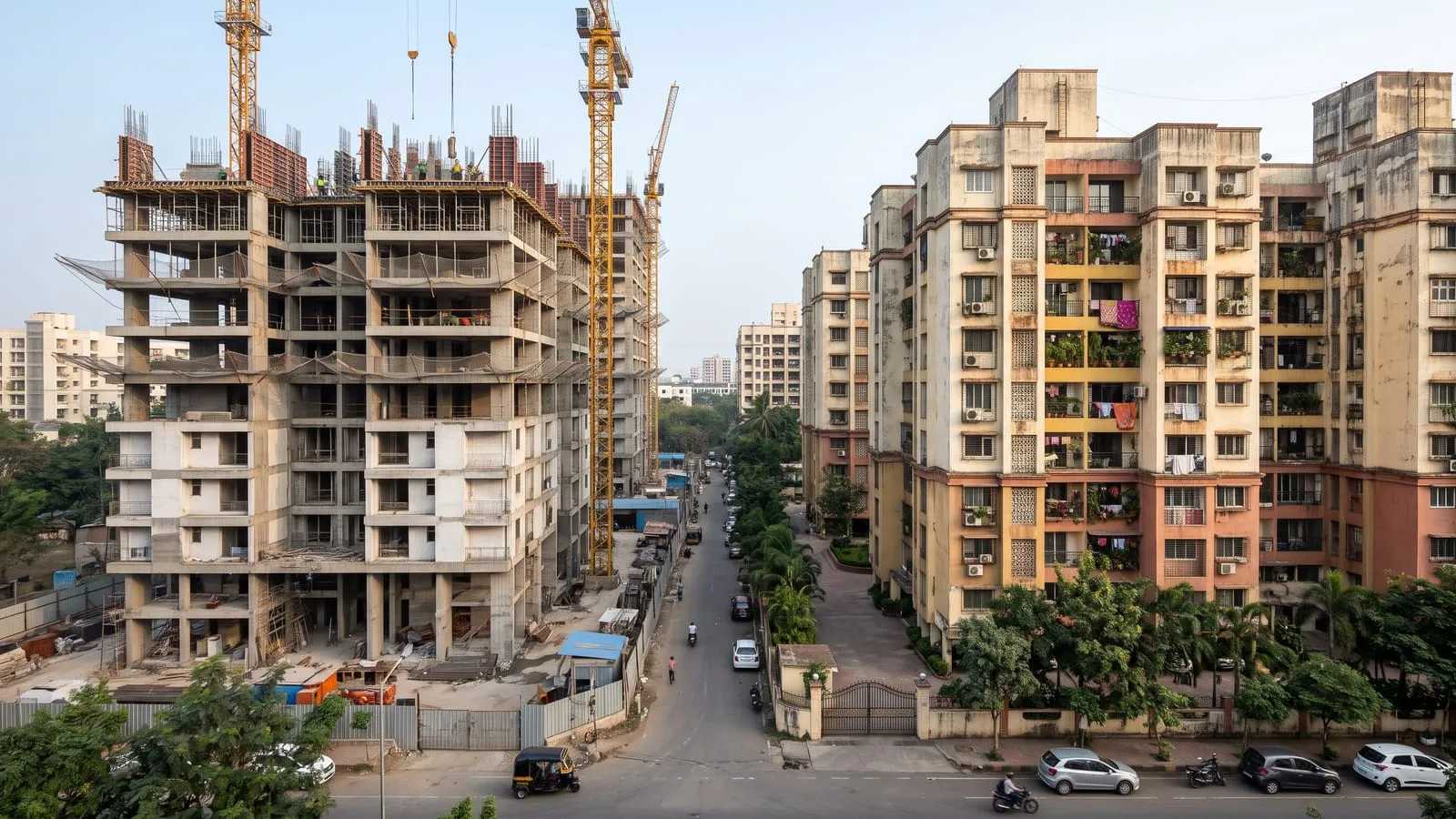 Illustrative image
New launch vs resale property in Gurugram: the short answer
New launch vs resale property in Gurugram is mostly a choice between paperwork you can check today and protections you rely on later. A new launch gives you HRERA rules, staged payments and a fresh building, but you pay GST and carry the delay risk. A resale flat is ready to see and pays no GST, yet everything depend on its OC and conveyance deed being in order.
Neither route is better for everyone; the right one turn on your budget and how soon you need the keys.
If your real question is about the stage of the building, our post on ready-to-move vs under-construction property in Gurugram covers possession time and rent paid while waiting. Here we stays with the route: who you buy from, what you sign and what it cost.
What counts as a new launch and what counts as resale
A new launch is a project the developer has just opened for booking. In Gurugram it must first be registered with HRERA, the Haryana Real Estate Regulatory Authority for Gurugram, which keeps the register of projects and their promised dates. You buy from the developer, usually before the towers is built.
A resale is a home bought from its current owner. Mostly it is a finished flat in a lived-in society, but it can also be an unfinished unit that an earlier buyer is selling on. In that case you step into the first buyer's agreement, so the developer's consent and its fee comes into play.
Two terms matter on both routes. Carpet area is the net usable floor area of a flat, as the RERA Act defines it in section 2(k), and sales under RERA are priced on it. Super area adds a share of walls and common spaces, and many older resale deals still quote it. So a per sq ft figure mean little until you know the basis.
What Gurugram's market is selling in 2026
The new launch in Gurugram today is mostly a premium product. Knight Frank India wrote in its H1 2026 report (9 July 2026) that nearly all new projects in Gurugram were introduced above ₹2 crore. For buyers below that line, resale flats in Gurgaon are often the only choice in the established sectors, not a second choice.
Supply is not short, though. Knight Frank counted 59,727 unsold homes in Gurugram at H1 2026, up 6% on a year, or 9.6 quarters of sales. It treats anything under 8 quarters as balanced. ANAROCK's Dwarka Expressway report (1 September 2026) put 10,770 unsold homes on that corridor in H1 2026, about 95% under construction and only 5% ready.
New registrations keeps coming. Our compilation of HRERA Gurugram's register shows about 19,600 units declared from January to September 2026 across 61 projects, after about 34,846 in 2025. Our list of new launches and the post on upcoming residential projects in Gurugram tracks the names one by one.
- One budget exception: ANAROCK's Q2 2026 launch list gives Antares by ROF in Sohna (HRERA GGM/1057/789/2026/29, 1,891 homes) a quoted launch rate of ₹3,600 per sq ft.
- Buyers are leaning toward finished stock, Knight Frank says, and the age of NCR's unsold stock fell from 14.8 quarters to 11.5 quarters between H1 2025 and H1 2026.
Free property updates
Never Miss a Property Opportunity!
Get the latest property news, investment opportunities, new launches and government plot scheme updates directly.
You're subscribed
One last tap so our WhatsApp updates reach you:
Say hello on WhatsAppIt opens a chat with +91 79824 13588, our main number. Save it in your contacts.
Launch price or resale price: what the headline hides
A launch price is the developer's list price, and it is rarely the whole story. Knight Frank's H1 2026 report says developers have broadly resisted formal price cuts and prefer incentives such as flexible payment plans, subvention schemes and stamp duty waivers. It warns that headline and effective prices can diverge materially, and that reported appreciation may overstate the gain a buyer actually sees at resale.
 Illustrative image
That cut both ways. No consultancy publishes a resale-versus-new price premium for Gurugram, so compare the two on the same area basis, sector and month.
For a reference point, our city tracker puts Gurugram's average asking price at ₹16,500 per sq ft (as of 11 October 2026). Our Gurgaon property rates page breaks this by locality, and our Gurgaon city page gives the wider context. Past growth on any line do not predict what comes next.
Resale vs new property: the cost items side by side
The cost of buying is more then the price. Collector rates are the district's minimum values for stamp duty; the duty is charged on the higher of the deal value and the collector-rate value.
| Cost item | New launch (from the developer) | Resale (from an owner) | Rule or source |
|---|---|---|---|
| GST | 5% without input tax credit; 1% for affordable homes (up to 60 sq m carpet in metros and ₹45 lakh) | None on a completed flat with a completion certificate | GST Council 34th meeting, 19 March 2019; Finance Ministry FAQ, 7 May 2019 |
| Stamp duty | 7% for men, 5% for women | 7% for men, 5% for women | Our state costs table; IANS, 28 July 2026 |
| Registration fee | Slab based, up to ₹50,000 | Slab based, up to ₹50,000 | IANS, 28 July 2026 (full slab table unconfirmed) |
| Advance before agreement | No more than 10% before a registered agreement for sale | Token amount set by the parties | RERA Act section 13(1) |
| Transfer charges | Not applicable on a first sale | No fixed rate on record; ask the developer or society in writing | Developer or society terms |
| Extra charges | PLC (preferred location charge), parking, IFMS (interest-free maintenance security) and EDC and IDC (external and infrastructure development charges) if billed separately | Unpaid maintenance or society dues of the seller | Developer price sheet; society statement |
Use our stamp duty calculator to run your own figure, and confirm the rate with the sub-registrar before you pay. Joint owners should ask what rate applies to them, because it isn't in the table above.
A ₹2 crore example, both ways
Here is a rounded example on a flat priced at ₹2 crore either way. It assume the deal value is above the collector-rate value, so duty is charged on ₹2 crore. The affordable 1% GST rate don't apply at this price.
| Item | New launch, ₹2 crore | Resale with OC, ₹2 crore |
|---|---|---|
| Price | ₹2 crore | ₹2 crore |
| GST at 5% | about ₹10 lakh | nil |
| Stamp duty, man buyer (7%) | about ₹14 lakh | about ₹14 lakh |
| Stamp duty, woman buyer (5%) | about ₹10 lakh | about ₹10 lakh |
| Registration fee (cap) | up to ₹50,000 | up to ₹50,000 |
| Total, man buyer | about ₹2.25 crore | about ₹2.15 crore |
| Total, woman buyer | about ₹2.2 crore | about ₹2.1 crore |
| Not included | PLC, parking, IFMS, any separate EDC and IDC | Transfer fee, seller's dues, repairs |
Source: GST rates from the GST Council (19 March 2019); stamp duty and registration cap from our state costs table and IANS (28 July 2026). The gap of roughly ₹10 lakh is the GST. But a resale flat of the same price may be older and need work.
Paperwork on a new launch: HRERA, the agreement and the 10% rule
On a new launch in Gurugram the law does a lot of the heavy lifting, if you uses it. Section 13(1) of the RERA Act says a developer cannot take more than 10% of the cost before signing and registering a written agreement for sale. Section 4(2)(l)(D) makes it keep 70% of buyers' money in a separate bank account for land and construction, withdrawn in proportion to work done.
 Illustrative image
Registration comes first. HRERA Gurugram's chairman cautioned buyers against unregistered projects in August 2026 and told developers not to run pre-launch ads before approvals, as Outlook Money reported citing the Hindustan Times. Section 59 of the Act makes advertising, booking or selling an unregistered project punishable. So a "pre-launch" offer with no HRERA number is a red flag, not a discount.
- If possession is late, section 18(1) lets you exit with a refund and interest, or stay and get interest for each month of delay.
- The Punjab and Haryana High Court said a buyer who has taken possession and signed a conveyance deed can still claim delay interest, ordinarily within three years of possession, as our news desk reported on 8 October 2026.
- Haryana's appellate tribunal reversed the cancellation of three Gurugram flats because the developer skipped its own notice steps; buyers in default can expect a 90-day window and at least 30 days' warning (our report on the tribunal ruling, 9 October 2026).
Our guide to RERA checks before booking walk through the register page by page.
Paperwork on resale flats in Gurgaon: OC and conveyance deed first
On resale, the two papers that matter most are the OC and conveyance deed. The OC, or occupation certificate, is the planning department's permission to live in the building. The conveyance deed is the document that transfers the title from developer to the buyer, and it is what the seller must be able to show you.
The RERA Act set timelines here too. Under section 17(1), absent a local law, the conveyance deed is due within three months of the OC. Section 19(10) asks allottees to take possession within two months of the OC. Section 14(3) gives five years from handover to report structural defects, which the developer must fix free within 30 days, so ask when the flat was handed over first.
Not every OC is what it look like, though. ThePrint reported on 31 July 2026 that DTCP scrutinised self-certified OCs issued from 1 July 2025 to 15 March 2026, and a district town planner said about 2,000 were issued illegally. This affect independent floors and plotted homes, not group-housing towers, but a resale floor buyer should check the OC on DTCP's own records. How many societies still lives without these papers is not published.
Risks and checks on each route, with Gurugram evidence
Each route carry its own kind of risk, and each have a check.
| Route | Risk | Gurugram record | Check |
|---|---|---|---|
| New launch | Late possession | HARERA ordered 10.8% a year delay interest to 26 Kavyam (Sector 108) allottees; deadline was 20 August 2023, no OC (The Tribune, 14 October 2026) | HRERA completion date, extensions, past orders against the developer |
| New launch | Developer dues | District administration moved to freeze accounts of 71 builders owing ₹486 crore in RERA dues (The Tribune, 30 September 2026) | Pending HRERA orders and recovery notices |
| New launch | Work stoppage | Outdoor construction halted from 5 to 20 November 2026 under a dust-control order (The Tribune, 10 November 2026) | Buffer in the promised date |
| Resale | Unsafe structure | MCG listed 87 dangerous buildings and ordered a Sector 109 tower razed (order 30 October 2026; Hindustan Times, 3 November 2026) | Structural audit status, MCG notices |
| Resale | Sealing for misuse | DTCP issued 1,319 show-cause notices and 662 restoration orders over commercial use of homes (The Times of India, 11 November 2026) | Current use of the floor, any DTCP notice |
| Resale | Invalid OC | About 2,000 self-certified OCs said to be illegal (ThePrint, 31 July 2026) | OC on DTCP records, site visit |
Stalled projects are mostly an older problem: ICRA said in March 2026 that about 94% of NCR's stalled inventory comes from projects launched before FY2017. Read our reports on Gurugram's 87 unsafe buildings and the restarted sealing drive before buying an older floor. Our guide to how to judge safety in Gurgaon projects goes further.
Loan, tax and holding costs on each route
Loans cost a little more than they did. The RBI raised the repo rate by 25 bps to 5.50% on 7 October 2026, as PSU Connect reported, and SBI's home-loan rates start at 7.50% a year from 15 October 2026 on its rate page. On a new launch the bank pays in stages as the building rise; ask who pay the interest under a subvention offer if the project is late. On resale, the bank want the full chain of title first.
 Illustrative image
Tax works different on each side. GST is paid only on the new launch route, as the cost table shows. Stamp duty is the same rate both ways but rises with the collector rate, and our reading of Gurugram's 2026-27 collector lists shows a median rise of 30% across 163 residential-land lines, effective 1 April 2026.
Holding costs is changing too. Haryana's new property tax works on capital value; a 30 July 2026 notification gave a start of 1 August, while our property tax report later said the system starts on 1 November 2026. Check the bill with MCG before you budget. Our home loan EMI calculator helps you test a loan at today's rates.
A checklist before you sign on either route
Run these steps in order. The first four apply to a new launch, the next four to resale, and the last two to both.
- Find the project on HRERA Gurugram's register and note its registration number and completion date.
- Ask for the price sheet on carpet area, with PLC, parking, IFMS and any EDC and IDC listed.
- Pay no more than 10% before a registered agreement for sale.
- Read the cancellation and delay clauses, and the developer's past HRERA orders.
- Get copies of the OC and the seller's conveyance deed, and match them to the flat number.
- Check the OC on DTCP records, especially for an independent floor.
- Get the transfer fee and any pending society dues in writing from the developer or society.
- Ask MCG whether the building is on its dangerous-buildings list or has a sealing notice.
- Work out stamp duty on the higher of the deal value and the collector-rate value.
- Get your bank's legal and technical approval before paying the balance.
For the developer side, our guide on how to vet a builder before you buy sets out the full method.
Which route fits which buyer
A new launch suits a buyer who has time, wants a newer building and is buying above ₹2 crore, where most fresh supply now sit. The price of that is GST and the risk of a late handover.
A resale suits a buyer who needs to move in soon, wants an established sector or has a budget the launches don't reach. The saving on GST is real, but it only count if the OC and conveyance deed are clean. Our list of ready-to-move projects is one place to start a resale search.
Whichever route you pick, check the papers before the money moves, and read the ready-to-move vs under-construction post linked above for the timing side.
Questions
Frequently Asked Questions
Is a resale flat in Gurugram cheaper than a new launch at the same price? +
On the purchase costs, yes, by roughly the GST. A completed flat with a completion certificate pays no GST, while an under-construction home pays 5%, or about ₹10 lakh on ₹2 crore. Stamp duty and the ₹50,000 registration cap are the same on both routes. Repairs, transfer fees and the age of the building can narrow that gap.
Do I pay transfer charges when I buy a resale flat in Gurugram? +
You may. No single rate is fixed by any rule on record, because the fee is set by the developer or the society, and it often applies when an unfinished unit changes hands. Ask for the amount in writing before you sign, and agree with the seller who pays it, so it is not a surprise at registration.
Which papers should I see before buying a resale flat in Gurgaon? +
Start with the OC and conveyance deed. The OC shows the building was cleared for living, and the conveyance deed shows the seller owns the flat. Also ask for the society's no-dues letter, the transfer fee in writing and any MCG or DTCP notices. For an independent floor, check the OC on DTCP's own records.
How much can a developer take before the agreement on a new launch? +
Under section 13(1) of the RERA Act, a developer cannot take more than 10% of the cost as an advance or application fee before signing and registering a written agreement for sale. If a new launch asks for more upfront, ask why, and do not pay until the agreement is registered and the HRERA number matches the project.
Is a pre-launch offer in Gurugram allowed? +
Not before the project is registered. HRERA Gurugram's chairman warned in August 2026 against unregistered projects and told developers not to advertise before approvals, as reported by Outlook Money citing the Hindustan Times. Section 59 of the RERA Act makes advertising, booking or selling an unregistered project punishable. Ask for the HRERA number before you pay anything.
Can I get a home loan more easily on a new launch or on resale? +
Both are possible, but the checks differ. On a new launch the bank releases money in stages as construction moves, and a subvention offer may cover interest for a time. On resale the bank checks the full chain of title, the OC and the conveyance deed first. SBI's home loan rates start at 7.50% from 15 October 2026.
Does stamp duty in Gurugram depend on the price I agree with the seller? +
Partly. Haryana charges stamp duty on the higher of the deal value and the collector-rate value, so a low agreed price does not lower the duty below the collector value. The rate is 7% for men and 5% for women, as listed in our state costs table. Collector values rose by a median 30% across residential-land lines for 2026-27.
Are newer projects in Gurugram less likely to stall than old ones? +
The record points that way, though nothing is certain. ICRA said in March 2026 that about 94% of NCR's stalled inventory comes from projects launched before FY2017, before RERA took full effect. Delays still happen: HARERA ordered 10.8% a year delay interest to 26 Kavyam allottees in October 2026. Check each project's HRERA history.
Sources
- Knight Frank India, India Real Estate: Office and Residential Market, January to June 2026 (H1 2026), NCR residential chapter, 9 July 2026
- ANAROCK Research, Dwarka Expressway Micro Market Report, 1 September 2026
- ANAROCK Research, Residential Market Viewpoints: National Capital Region Q2 2026, 3 August 2026
- Property Nivesh research desk, compilation of HRERA Gurugram registration lists, 30 September 2026
- Government of India, The Real Estate (Regulation and Development) Act, 2016 (sections 2(k), 4(2)(l)(D), 13(1), 14(3), 17(1), 18(1), 19(10), 59)
- Press Information Bureau (Ministry of Finance), Decisions taken by the GST Council in the 34th meeting regarding GST rate on real estate, 19 March 2019
- Ministry of Finance, Department of Revenue (Tax Research Unit), FAQs on real estate, 7 May 2019
- NewKerala (IANS), Haryana Cabinet cuts stamp duty, registration fee on dwelling units for weaker sections, 28 July 2026
- Property Nivesh, state costs table (Haryana row), November 2026
- Outlook Money, citing Hindustan Times, Haryana RERA warns homebuyers against investing in unregistered projects, 17 August 2026
- The Tribune, Gurugram HARERA directs builder to pay 10.8% delay interest to 26 Kavyam homebuyers, 14 October 2026
- The Tribune, Pay up or face arrest: Gurugram to freeze accounts of 71 builders over Rs 486 crore RERA dues, 30 September 2026
- The Tribune, Gurugram construction ban hits realty sector; developers seek CAQM review, 10 November 2026
- Hindustan Times, Gurugram civic body declares a Sector 109 tower dangerous, directs builder to raze it within three months, 3 November 2026
- The Times of India, Sealing to restart against PGs, hotels set up at housing units in Gurgaon, 11 November 2026
- ThePrint, Gurugram's OC scam: how an official certificate leaves buyers stuck in unfinished homes, 31 July 2026
- ICRA Limited, Indian residential real estate: easing of stalled inventory, March 2026
- PSU Connect, RBI hikes repo rate by 25 bps to 5.50%, 24 October 2026
- State Bank of India, Home Loans Interest Rates, effective 15 October 2026
- Property Nivesh research desk, reading of District Administration Gurugram collector-rate lists 2025 and 2026-27, April 2026
- Property Nivesh news desk: Tribunal voids unit cancellations (9 October 2026); Delay compensation after possession (8 October 2026); Haryana property tax overhaul (24 October 2026)
- Property Nivesh city tracker, Gurgaon average asking price, as of 11 October 2026