Investment Guides
Dwarka Expressway in 2026: Is the Second Re-Rating Coming?
The corridor already delivered 160% in five years. We break down what drives the next leg — metro, Global City, commercial supply — and exactly where the risks hide.
By the PropertyNivesh Research Desk · Edited by Rakesh Mahajan · · 9 min read
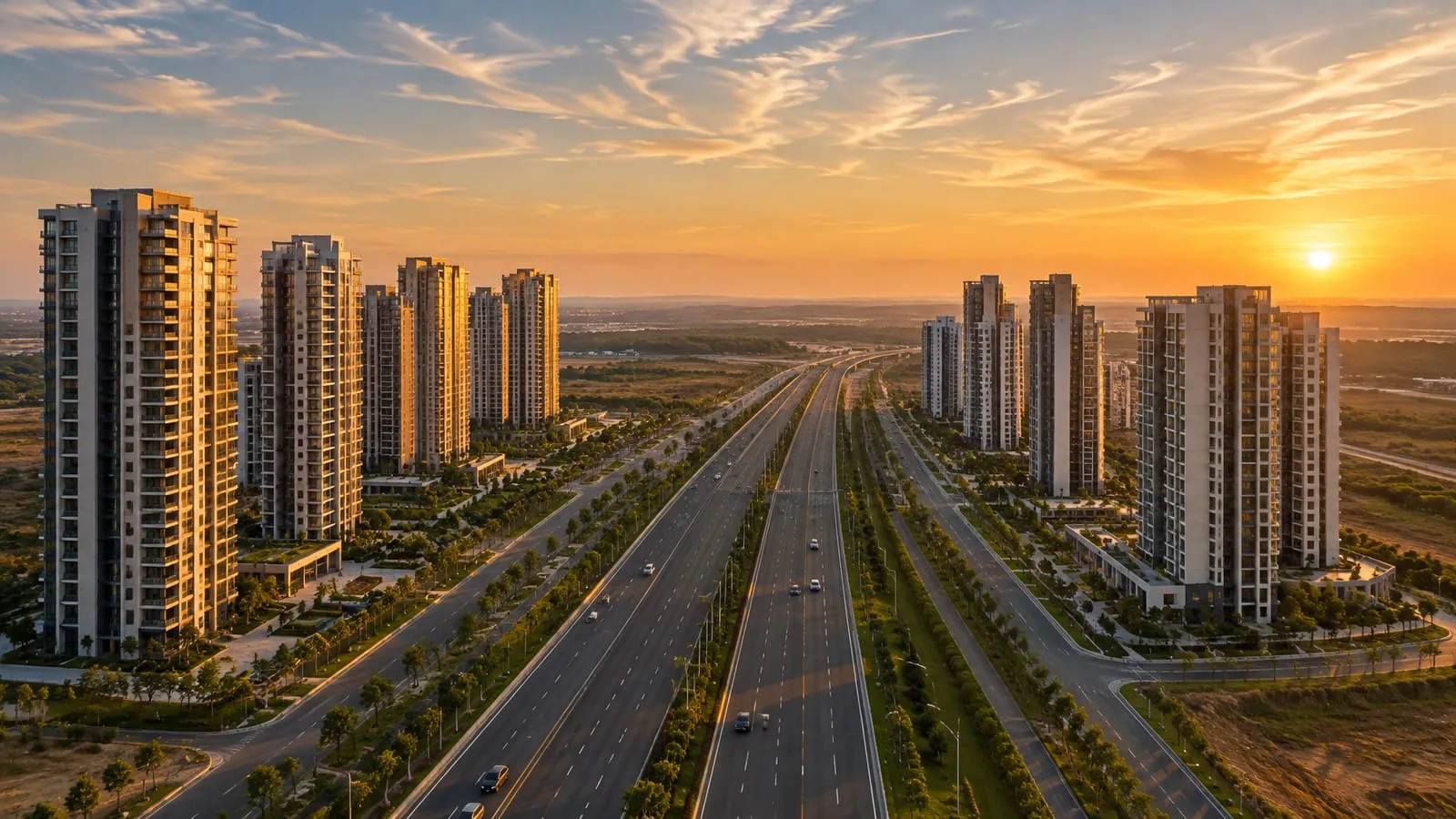
The question every buyer is asking
Between 2020 and 2024, Dwarka Expressway prices moved from roughly ₹5,200 to ₹12,500 per sq ft — a repricing driven by one binary event: the 29-km elevated expressway actually opening. That risk is now retired, and so is the easy money. The question buyers should ask in 2026 is not 'has it grown' but 'what specifically drives the next 50%' — and whether their entry price already assumes it. This guide answers that with the framework our advisory desk uses on live client mandates.
The short version: the corridor remains one of India's best structural growth stories, but returns from here will come from project selection rather than corridor selection. Buying anything on the expressway worked in 2021. It does not work in 2026.
What the first re-rating already priced in
It helps to be precise about what the 160% move actually paid for, because whatever is already priced cannot pay you again:
- The expressway opening itself — the binary construction risk that suppressed prices for a decade is gone
- Airport proximity re-discovery — the 15–20 minute IGI access became credible once the road was drivable
- The Yashobhoomi convention centre — India International Convention Centre operating at the Delhi end
- Big-brand arrival — DLF, Sobha, Godrej and Signature Global launching flagship projects legitimised the corridor
- Investor velocity — a large share of 2021–24 purchases were investors, which inflates prices faster than end-user demand justifies
The three catalysts for a second leg — with our probability calls
We assign explicit probabilities to the remaining catalysts, because vague optimism is how buyers overpay:
| Catalyst | Impact if delivered | Our probability | Timeline |
|---|---|---|---|
| Metro along the corridor | High — converts investor stock to end-user demand | High (alignment studies funded) | By ~2029–30 |
| Global City Phase 1 (1,000 acres) | High — adds employment, not just housing | Medium | First phase ~2028 |
| Cyber City 2 / commercial cluster | Very high — would repeat Golf Course Road's history | Speculative | No committed timeline |
If the metro lands on schedule, we model corridor-average appreciation of 12–16% CAGR for quality projects over five years. If it slips beyond 2030, expect a plateau: 6–9% with weak resale liquidity in investor-heavy towers.
The supply problem nobody prices
Sectors 102–113 hold one of India's largest premium launch pipelines. In heavy-supply corridors, the builder's brand is what protects resale value — established builders with strong delivery records tend to hold value better at exit than the corridor average. Three practical implications:
- Prefer Sobha, DLF, Godrej and Signature Global product even at a 15–25% premium to commodity towers — the premium comes back at resale
- Avoid towers where investors dominate the buyer mix; ask the sales team for the end-user ratio and discount their answer
- Studio and compact investor formats will face the most churn if the metro slips — family formats (3 BHK+) hold better
Where the value sits today: our corridor map
| Micro-pocket | Avg rate (Aug 2026) | Character | Desk stance |
|---|---|---|---|
| Sectors 104–108 (mid-corridor) | ₹13,000–22,000 | Flagship luxury cluster (Sobha Altus at ₹22K) | Buy quality selectively |
| Sectors 102–103 (Delhi end) | ₹14,000–16,000 | Convention-centre adjacency, Godrej Vrikshya | Buy for 2030 horizon |
| Sectors 109–113 (Gurgaon end) | ₹11,000–14,000 | Dense pipeline, most investor stock | Selective — brand only |
| Sector 99–102A (established) | ₹10,000–12,500 | Older possession-ready stock | Value for end-users now |
Ready-to-move stock at the established end trades at a meaningful discount to new launches — an inversion of the normal premium — because launch marketing dominates the corridor. End-users should exploit that gap.
Checklist before you book on the corridor
- Verify the project's RERA possession date on HRERA Gurugram — not the brochure date
- Compare your quote against at least three same-sector comparables on a carpet-area basis
- Insist on a construction-linked plan; avoid heavy-upfront 'subvention style' schemes
- Check the builder's corridor-specific delivery record, not just their citywide brand
- Model your exit at metro-delivered AND metro-delayed scenarios before committing
- If investing for rental, underwrite at today's rents (~₹28–38/sq ft/month), not projected ones
Our verdict: accumulate quality on dips, avoid commodity towers, and use construction-linked plans. A 5–7 year horizon can reasonably target 12–16% CAGR from here — good, not spectacular. The 2021-style doubling is behind us, and anyone selling you that story is selling you their inventory.
The mistakes corridor buyers keep repeating
- Extrapolating 2021–24 returns forward — the 160% move paid for a binary event that cannot happen twice; the next leg has different, slower drivers
- Buying the cheapest tower on the corridor — in oversupplied markets the discount IS the warning; commodity stock has underperformed quality here by 25–40% at resale
- Ignoring the investor mix — towers sold 70% to investors face synchronized exit pressure the moment sentiment turns or the metro slips
- Confusing site visits on Sunday with living there on Monday — drive the service roads at 9 am; the elevated expressway is fast, the last kilometre often isn't
- Underwriting rentals at projected rents — today's ₹28–38/sq ft/month is the honest number; brochures quoting 2030 rents are selling you their optimism
- Skipping the RERA possession date because 'big builders deliver' — even elite sponsors carry 6–12 month drifts; your rent-plus-EMI budget must survive them
Quick answers to the questions buyers actually ask
- Is it too late to buy on Dwarka Expressway? — For doubling, yes. For 12–16% CAGR in quality projects over 5–7 years, no — that remains our base case if the metro lands
- Which sectors are safest? — The mid-corridor flagship cluster (104–108) for luxury; the established 99–102A belt for value end-use. The Gurgaon-end pipeline needs the most selectivity
- Should I buy a studio for rental income? — We generally advise against corridor studios until the metro is committed; family formats hold value and tenants better
- UC or RTM here specifically? — The corridor inverts the usual premium: established-end RTM trades below new launches. End-users should exploit that; investors can take quality UC
- What kills the thesis? — Metro slipping past 2030 plus continued launch velocity. Watch approvals, not renders: alignment tenders are the tell
- What's a fair price today? — ₹11,000–14,000 for quality mid-market, ₹18,000–23,000 for true luxury specification. Quotes materially above these bands need a project-specific justification
For project-level calls on the corridor, our researched pages on Sobha Altus, Godrej Vrikshya and the Signature Global launches carry full score cards — and the advisory desk tracks weekly pricing across all of Sectors 99–113.